

This infographic was originally published as part of the “CDFA By the Numbers” report in 2016. More information about CDFA’s State Organic Program is available here.
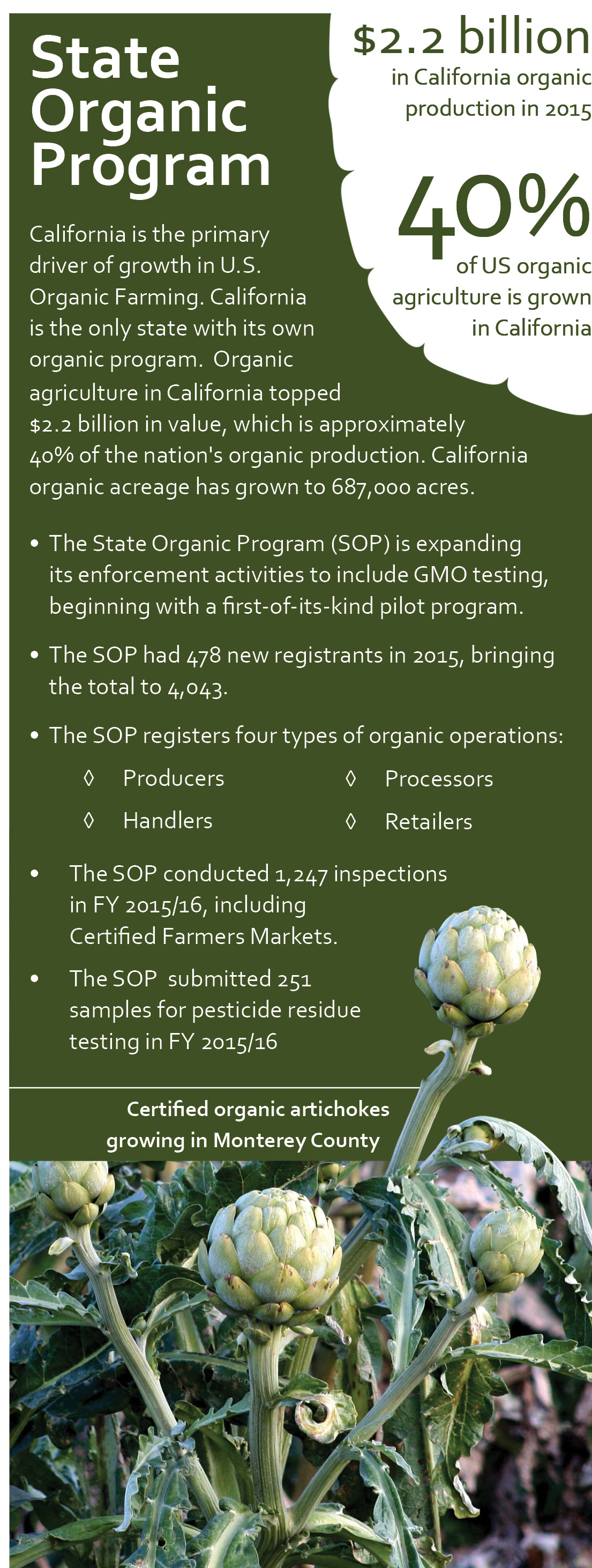


This infographic was originally published as part of the “CDFA By the Numbers” report in 2016. More information about CDFA’s State Organic Program is available here.
A joint Soil Health Summit hosted by CDFA and the USDA’s Natural Resources Conservation Service is underway today at CDFA headquarters. A webcast of the meeting may be accessed here, and the agenda may be viewed here. CDFA Secretary Karen Ross made opening remarks this morning.

SACRAMENTO, Calif. – A new report from several California agencies tracks the significant progress made in 2016 toward achievement of the California Water Action Plan – progress that builds the reliability and resiliency of our water resources.
The report released today highlights the achievements of 2016, the third year that state agencies have been coordinating efforts under the Water Action Plan. First released by the administration of Governor Edmund G. Brown Jr. in January 2014, the Water Action Plan is a five-year framework with 10 overarching goals designed to bring sustainability to California’s water resources and restoration to its most important ecosystems.
The plan’s major goals include making conservation a way of life, increasing regional self-reliance in water supplies, managing and preparing for dry periods, and providing safe water for all communities. The plan is the foundation for expenditures under Proposition 1, the $7.5 billion water bond passed overwhelmingly by California voters in November 2014.
The 2016 summary of accomplishments was prepared by the California Natural Resources Agency, California Environmental Protection Agency, and the California Department of Food and Agriculture.
“We built momentum in 2016 that we intend to maintain in 2017 and beyond,” said California Natural Resources Secretary John Laird. “United by the Water Action Plan goals and enabled by the Proposition 1 funds, we are making investments that will pay off for generations to come.”
California Agriculture Secretary Karen Ross said, ““This plan is critically important beyond the year-to-year fluctuations we experience in precipitation. Looking ahead, we know that we must work together to make every drop of water count in California.”
“The drought has highlighted the challenges California faces under climate change,” said CalEPA Secretary Matt Rodriquez. “The Water Action Plan serves as an invaluable guide to ensure that our short-term responses to the drought are also being translated into actions that make our water system more sustainable and resilient over the long term.”
Some of the 2016 achievements described in the California Water Action Plan Implementation Report – 2016 Summary of Accomplishments include:
For more information about the California Water Action Plan, visit http://resources.ca.gov/california_water_action_plan/.
Link to news release on California Resources Agency web page.
SACRAMENTO—Governor Edmund G. Brown Jr. today proposed a balanced state budget that eliminates a projected $2 billion deficit and bolsters the state’s Rainy Day Fund while continuing to invest in education, health care expansion and other core programs.
In a letter to the Legislature, the Governor explained that while this year’s budget “protects our most important achievements,” it is also “the most difficult that we have faced since 2012” and “uncertainty about the future makes acting responsibly now even more important.”
Significant details of the Governor’s 2017-18 State Budget include:
Keeping the Budget Balanced
The budget proposes $3.2 billion in solutions to ensure a balanced budget. By tempering spending growth rather than cutting existing program levels, these actions minimize the negative effects on Californians. The solutions include adjusting Proposition 98 spending, recapturing unspent allocations from 2016 and constraining some projected spending growth. In total, General Fund spending remains flat compared to 2016-17.
Bolstering State Reserves
Proposition 2 establishes a constitutional goal of having 10 percent of tax revenues in the state’s Rainy Day Fund. With a $1.15 billion deposit in the budget, the Rainy Day Fund will total $7.9 billion by the end of 2017-18, 63 percent of the constitutional target. While a full Rainy Day Fund might not eliminate the need for further spending reductions in case of a recession or major federal policy changes, saving now would allow the state to soften the magnitude and length of necessary cuts.
Increasing Education Funding
K-14 funding is expected to grow to $73.5 billion in 2017-18, up 55 percent – or $26.2 billion – from 2011-12. For K-12 schools, funding levels will increase by about $3,900 per student in 2017-18, over 2011-12 levels. This reinvestment provides the opportunity to correct historical inequities in school district funding with continued implementation of the Local Control Funding Formula.
Continuing Health Care Expansion
Under the optional expansion provisions of the federal Affordable Care Act, the budget increases enrollment of this Medi-Cal population to 4.1 million Californians, with the state’s General Fund share of cost increasing from $888 million to nearly $1.6 billion.
Counteracting Poverty
California has an extensive safety net for the state’s residents who live in poverty. Since 2012, the General Fund has invested about $18 billion annually to help those in poverty. The budget continues to fund:
Strengthening Transportation Infrastructure
Annual maintenance and repairs of California’s highways, roads and bridges are billions of dollars more than can be funded annually within existing revenues. The budget reflects the Governor’s transportation package, first proposed in September 2015, which would provide $4.2 billion annually to improve the maintenance of highways and local roads, expand public transit and strengthen critical trade routes.
Combating Climate Change
The state has appropriated $3.4 billion in cap-and-trade auction proceeds to help reduce greenhouse gas emissions, with funding prioritized in disadvantaged communities. With volatility in recent auctions due in part to uncertainty about the program’s post-2020 future, the Administration proposes two-thirds urgency legislation to confirm the program’s continued authority beyond 2020. Assuming approval, the budget proposes $2.2 billion in expenditures from auction proceeds, with a continued emphasis on low-income and disadvantaged communities.
The full summary of the Governor’s budget proposal can be found at www.ebudget.ca.gov.
Link to Governor Brown’s website.
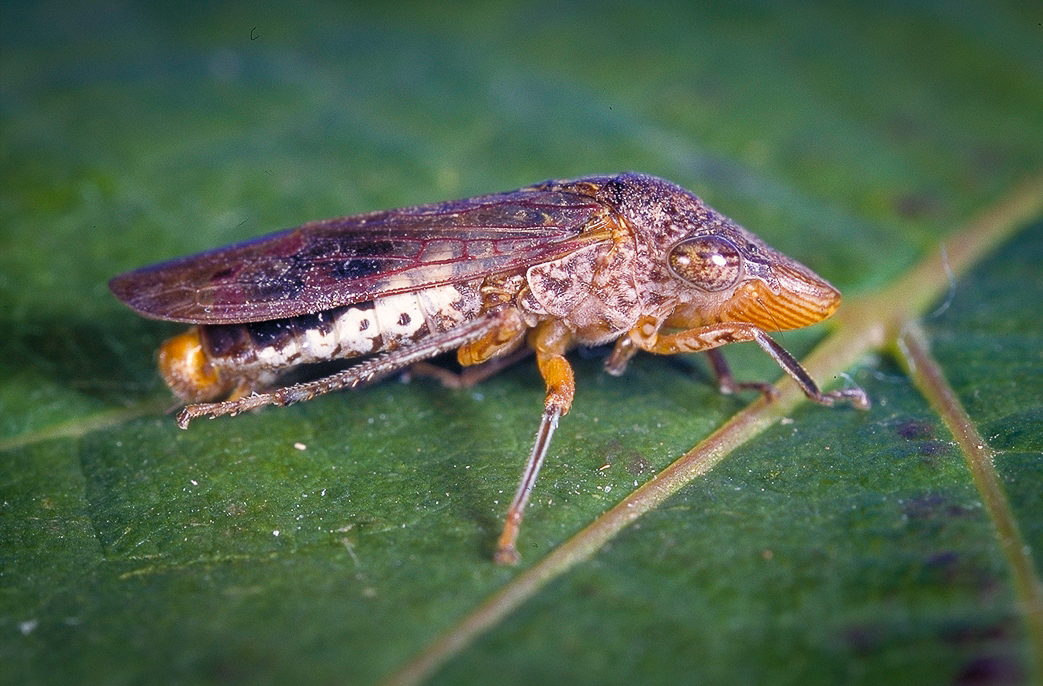
The glassy-winged sharpshooter spreads Pierce’s disease.
Authorities in San Diego Monday announced a $160,328 settlement against two related plant businesses as part of a civil environmental prosecution alleging the companies unlawfully distributed infested and potentially infested plants throughout the state in May 2014 and February 2015.
The agreement by Plant Source Inc. and Viva Farms LLC resolves allegations made in a lawsuit that claimed the distributors unlawfully sold and transported plants throughout California in violation of the Pierce’s Disease Control Program. The program was established by the state Legislature in response to a statewide agricultural emergency caused by a plant-killing disease that affects California’s grape industry and other agricultural commodities.
“Skirting built-in protections brings consequences,” said District Attorney Bonnie Dumanis. “Environmental laws and programs exist to keep our agriculture and environment safe and thriving for all Californians and visitors.”
The California Department of Food and Agriculture and the county of San Diego Department of Agriculture, Weights and Measures investigated the case.
They found that in May 2014, Plant Source, operating under an agreement to comply with the disease control program, failed to follow requirements and unlawfully shipped 35 separate shipments containing 624 crape myrtle plants to Home Depot stores in California.
Seven of the 35 shipments were found to be infested with glassy-winged sharpshooter egg masses. The insect is a large leafhopper, which carries and spreads the plant-killing Pierce’s disease, which can devastate entire crops.
Plant Source was placed under additional plant-shipping restrictions after the 2014 investigation. However, the company again failed to follow the program requirements in February 2015 and unlawfully shipped 48 plants to a non- infested area of San Luis Obispo County, and 315 palm trees to a non-infested area of Imperial County.
Plant Source and Viva Farms cooperated throughout the investigation and worked to enhance their policies and procedures to eliminate improper transporting, officials said.
“This judgment makes it abundantly clear how serious Pierce’s disease is for California,” Department of Food and Agriculture Secretary Karen Ross said. “Whether you sell plants, harvest grapes, make wine, or enjoy grapes at the table, the rules at the core of this case benefit the public by preventing the spread of disease and protecting the vines that are the center of California’s world-class vineyards.”
The USDA has released the 2015 Expenditures on Children by Families report, also known as “The Cost of Raising a Child.” The report, developed by economists at USDA’s Center for Nutrition Policy and Promotion (CNPP), estimates that for a child born in 2015, a middle-income* married-couple family will spend between $12,350 and $13,900 annually (in 2015 dollars) – or $233,610 from birth through age 17 – on child-rearing expenses. Families with lower incomes are expected to spend $174,690 and families with higher incomes are expected to spend $372,210 from birth through age 17. Many state governments use this annual report, first issued in 1960, as a resource in determining child support and foster care guidelines.
The report details spending by married-couple and single-parent households; for married-couple households, spending in various regions of the country are examined. Housing (29 percent) and food (18 percent) account for the largest share of child-rearing expenses for middle-income, married-couple families, followed by childcare/education (16 percent), transportation (15 percent), and health care (9 percent). Clothing was the smallest expense, at 6 percent, and other miscellaneous child-rearing necessities from birth to age 18 accounted for 7 percent. This report does not include costs related to pregnancy or college costs.
“When CNPP first issued this report in 1960, housing and food were the two highest expenses, just as they are today,” said CNPP Executive Director Angie Tagtow. “But while housing costs have increased over time, changes in American agriculture have resulted in lower food costs, and family food budgets now represent a lower percentage of household income.”
Across the country, costs were highest in the urban Northeast, urban West, and urban South; while lowest in the urban Midwest and rural areas. Much of the regional variation in expenses was related to housing. Differences in child care and education expenses also contributed to regional variation. Overall, child-rearing expenses in rural areas were 24 percent lower than those in the region with the highest expenses, the urban Northeast.
It is important to note that child-rearing costs vary greatly depending on the number and ages of children in a household. As family size increases, costs per child generally decrease.

The Planting Seeds blog will feature stories this month relating to animal health issues and the activities of CDFA’s Division of Animal Health and Food Safety Services. CDFA works closely with the University of California on these issues.
By Pamela Kan-Rice, UC Agriculture and Natural Resources
The same weather radar technology used to predict rain is now giving UC researchers the ability to track wild birds that could carry the avian influenza virus. Avian influenza, which kills chickens, turkeys and other birds, can take a significant economic toll on the poultry industry. In 2014-15, the United States experienced its worst bird flu outbreak in history, resulting in more than 48 million birds dying in 15 states, including California.
“We use the existing network of weather radar stations in the U.S. in the same way that radar is used to track rain, except that we process the data to allow us to interpret the radar signal bouncing off birds instead of raindrops,” said Maurice Pitesky, UC Cooperative Extension poultry specialist. “The data can be interpreted to track birds.”
NEXRAD, or next-generation radar, is a network of 160 high-resolution S-band Doppler weather radars operated by the National Weather Service. The technology works best for tracking birds in the winter during feeding. When waterfowl leave their roosting locations in concert to feed, their bodies produce reflectivity of the radar beam.
“By tracking mass bird movements remotely in real time, we hope to gain novel strategic insights with respect to surveillance and prevention of avian influenza transmission to domestic poultry,” said Todd Kelman, a veterinarian and engineer who co-leads the project with Pitesky, who is also in the School of Veterinary Medicine at UC Davis. They are exploring how the information might be used to prevent an outbreak.
In California, waterfowl migrate by the millions from September through March via the Pacific Flyway, where they winter in wetlands, rice and corn fields. The Central Valley alone is home to 3 million waterfowl at the height of migration.
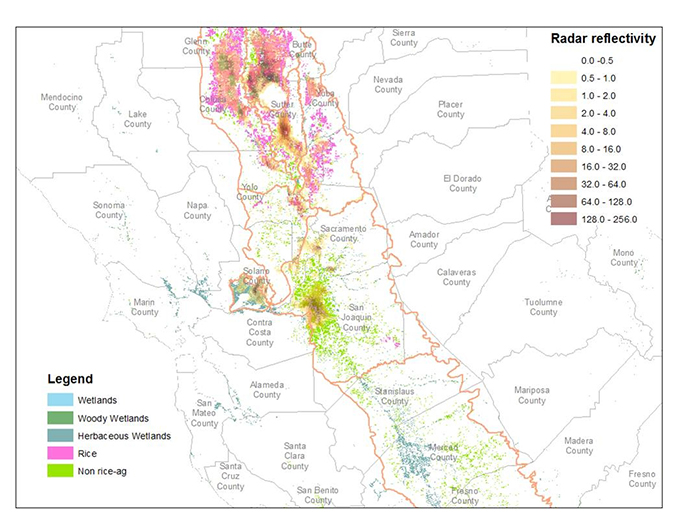
“Using NEXRAD and various other approaches, we hope to be able to produce monthly or quarterly maps that will alert poultry producers as to the locations of waterfowl in the Central Valley of California,” Pitesky said.
“Waterfowl populations can have different habitat based on the amount of precipitation in a given year,” said Pitesky. “Therefore, we need to use these types of monitoring tools to understand where waterfowl are located. Landsat, or satellite-based land imagery, and NEXRAD are two remote tools that may be very useful, as opposed to flyovers and banding, which are more expensive and not practical for large geographical areas.”
The project — funded by UC Agriculture and Natural Resources — is a collaboration between UC Davis School of Veterinary Medicine and Jeff Buler, University of Delaware wildlife ecologist whose team first developed the NEXRAD approach in the Central Valley of California. They also are working with the U.S. Geological Survey, the California Department of Food and Agriculture, the California Poultry Federation, the Pacific Egg and Poultry Association and Point Blue, an organization that focuses on conservation science.
CDFA takes precautions to prevent bird flu and other avian diseases
CDFA’s Division of Animal Health and Food Safety Services protects:
By David Gelles
EXCERPTED
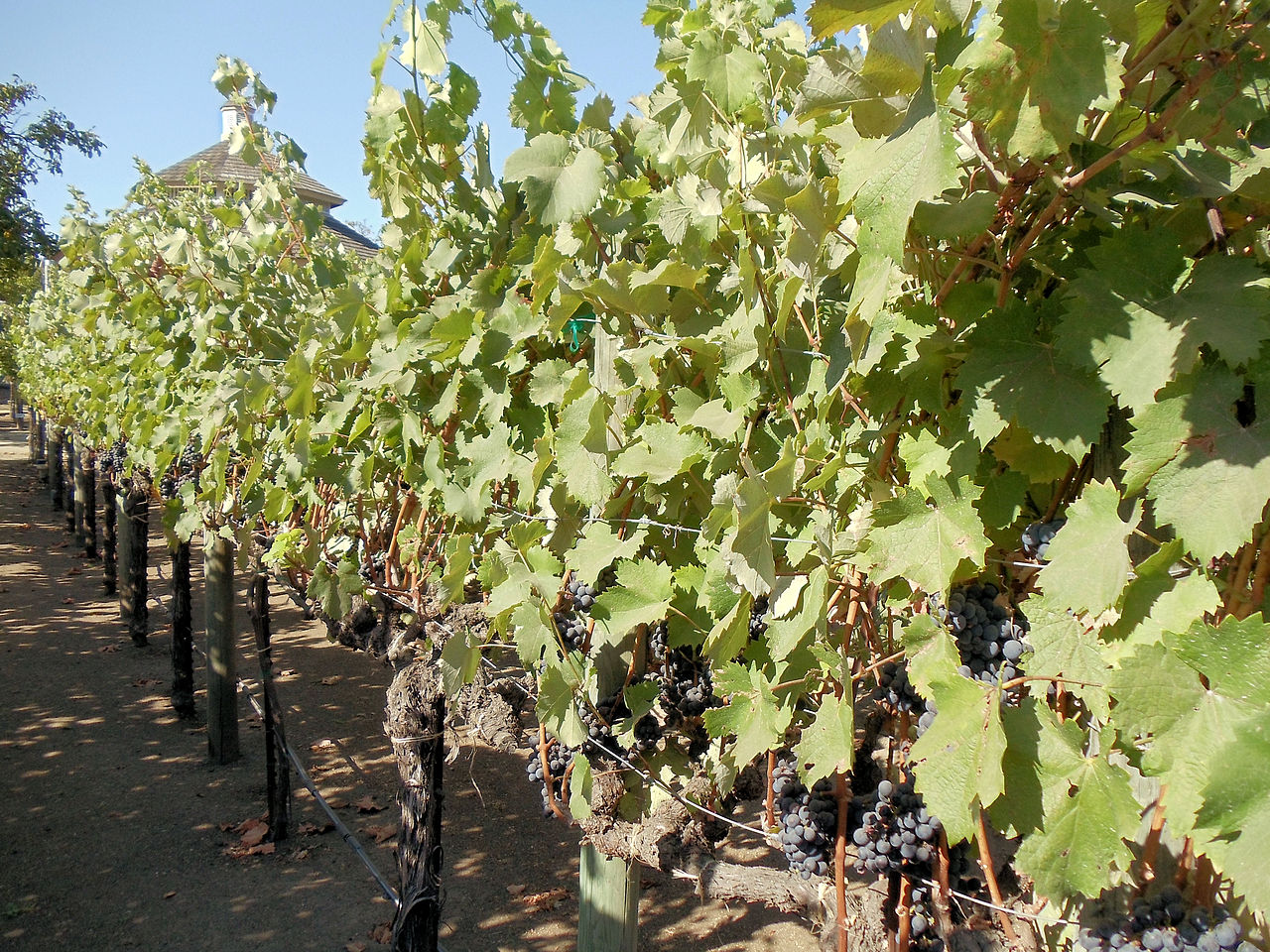
On a misty autumn morning in Sonoma County, Calif., Katie Jackson headed into the vineyards to assess the harvest. It was late in the season, and an army of field workers was rushing to pick the grapes before the first rains, however faint, began falling.
But on this day, Ms. Jackson, the vice president of sustainability and external affairs at Jackson Family Wines, was not just minding the usual haul of cabernet, chardonnay and merlot grapes. She also checked on the sophisticated network of systems she had put in place to help crops adapt to a changing climate.
As California endures a years-long drought, the Jacksons, like other winemakers, are grappling with new realities. Grapes, though a surprisingly resilient crop, are ripening earlier. Nights are warmer. Aquifers are running dry.
The Jacksons are going beyond the usual drought-mitigation measures. They are using owls and falcons, to go after pests drawn by the milder winters. They are finding new ways to capture rainfall. And since fossil-fuel consumption is one of the biggest drivers of climate change, they are trying to become more energy efficient, in part through the use of old-school farming techniques.
Climate change is forcing the Jacksons to confront questions both practical and existential: Can you make fine wine with less water? Will good grapes still grow here in 20 years? What will become of an industry central to California’s identity, one that says it contributes $114 billion a year to the nation’s economy?
————————————-
So far the drought has not wreaked havoc on the California wine business. No harvests have been destroyed and quality remains strong. Moreover, many of the Jackson vineyards are in pockets of the California coast that benefit from the cool, humid fog.
But the challenges here are hardly theoretical. Already, climate change is threatening the world’s coffee supply. Several reports suggest that rising temperatures around the globe could imperil major winemaking regions in the coming decades. One study suggested that by 2050, many regions in Europe, including much of Italy and swaths of Southern France, could become unsuitable for wine grapes. The same study suggested that California production could fall by 70 percent by the century’s midpoint.
———————————-
The clearest sign of the Jackson family’s efforts can be found in the network of more than 100 reservoirs scattered across its vineyards. Some have cost as much as $1.5 million to build.
On this morning, Ms. Jackson was visiting a reservoir on the sloping hills of the Stonestreet Estate Vineyards. The property is home to 800 acres of merlot, cabernet and chardonnay grapes, and another several thousand acres of uncultivated land.
Though it was late in the summer, the reservoir, which draws groundwater from a well, was still full. Two deer were drinking at its edge. The reservoir is connected to a gravity-fed drip irrigation system that pulls the water down the hills and through the vineyards. It now provides most of the water for the winery, which previously relied on wells and rain.
“We’ve seen a really sharp decrease in rainfall,” Ms. Jackson said. “Having these in place meant we were able to have enough water to get us through the year. It’s the biggest thing we’ve done to deal with the drought.”
———————————–
As California heats up, winemakers are confronting new challenges large and small — some very small.
Mice, voles and gophers love vineyards. “We’re seeing more pest pressures due to warmer winters,” Ms. Jackson said, walking through rows of cabernet grapes. Another emerging issue: Grapes ripen earlier, and swallows and crows are eating fruit before the harvest. “It’s a big problem,” she said.
That explains the owls. Sixty-eight boxes are occupied by hungry barn owls; during the harvest, a falconer comes to some vineyards every day, launching a bird of prey to scare away other birds with a taste for grapes.
——————————
The Jacksons have begun analyzing their crops with increasingly sensitive tools. Ms. Jackson recently installed devices that measure how much sap is in the vines. They transmit the data over cellular networks to headquarters, where software calculates how much water specific areas of vineyards do or don’t need. “Data-driven farming,” Ms. Jackson said.
The Jacksons are also monitoring their crops using drones equipped with sensors that detect moisture by evaluating the colors of vegetation. The wrong color can indicate nutritional deficiencies in the crops, or irrigation leaks.
Not all the changes being made on the Jackson vineyards involve advanced technology. Some are simply ancient farming techniques that the drought has made increasingly relevant.
Field hands plant cover crops, like rye and barley, between every second row of vines, to help keep the soil healthy. The family is stepping up its composting program. Pressed grapes are composted, then placed beneath rows of vines, since the organic matter is better at retaining moisture than soil.
———————————-
Ms. Jackson is overseeing an ambitious groundwater recharge project. This winter, the company plans to capture storm water runoff and flood a large, flat vineyard near its La Crema winery. If all goes as planned, the water will seep down and help replenish an aquifer from which the farm draws.
“My family knows we aren’t out of the drought yet,” Ms. Jackson said. “There’s still a lower snowpack. There’s less groundwater in the Central Valley.”
By Joseph Serna and Paige St. John
The resort town of Phillips high in the Sierra Nevada has long been a barometer of California’s drought.
Snow measuring station 3 in the El Dorado County town was where Gov. Jerry Brown came in April 2015 to announce major drought restrictions, using the dry, snow-less landscape as a stark backdrop.
“While that seems perhaps a little gloomy, keep in mind that we had pretty much bare ground here about a week ago,” Gehrke said.
The measurement came as the latest in a series of storms dumped heavy rain and snow across Northern California. The region had its wettest October in 30 years in 2016, followed by above-average precipitation December. More than 20 inches of snow dropped across the northern Sierra Nevada last weekend and another set of storms could provide an additional four feet by early next week, said Zach Tolby of the National Weather Service.
Melted snow provides 30% of the state’s water as it flows into streams, rivers and reservoirs over the spring and summer.
The conditions haven’t added up to a drought-buster quite yet. But officials said that if the wet conditions extend into the spring, 2017 could prove a turning point for the epic dry spell.
“Generally speaking, to get out of the drought California would need to establish a trend of above-average snow-water content, above-average storage in reservoirs and above-average precipitation,” said Doug Carlson, a spokesman for the Department of Water Resources. “We’re on a great trend. We’d like to see it all year.”
The statewide snowpack measurement was 70% of the seasonal average Tuesday. The current water content in the northern Sierra Nevada is 68% of average for this time of year; the central Sierra clocked in at 65% and the southern Sierra at 73%, according to the Department of Water Resources.
The reservoirs are closer to normal levels. According to Tuesday’s data, Lake Shasta reservoir was at 118% of its historical average, while Lake Oroville, the biggest contributor to the State Water Project, was 91% of its historical average.
Water officials stressed that other parts of the state remain mired in serious drought.
In Tulare County, residents still receive rationed water. Southern California remains significantly dryer than in the north, despite a month of healthy rain in December. Moreover, warmer temperatures across the state are causing the snow to melt quick, and making the water more difficult to capture for use in cities and farmlands.
But in the Sierra, signs of drought conditions are getting harder to find.
Interstate 80 travelers trapped in Truckee below the infamous Donner Pass overnight Monday were able to leave Tuesday during a brief break in the snow storm.
After the break, said Marilyn Colquhoun at the California Welcome Center in Truckee as she read the week’s weather forecast aloud, “it is snow, snow, snow showers, rain — that’s not good — then snow, snow, snow.”
Following three years of drought with minimal Sierra snowpack, Colquhoun was enthusiastic about the squall.
“It will be a mess,” she said. “It’s a great storm!”
Transportation was already snarled again by early Tuesday afternoon, and requirements to install snow chains had created delays on Interstate 80 heading over the mountain passes. Colquhoun said Greyhound and Amtrak buses were delayed, “but still expected.”
The nonprofit Avalanche Warning Center posted warnings Tuesday for increased danger in popular backcountry ski areas, elevating the warnings by the evening from “considerable” to “high,” the greatest warning.
Drifting snow on high ridges and slopes already showed signs of wind slabs that could come crashing down. The combination of new heavy snow and a deep ice crust laid down by rain two weeks ago will increase the hazards. Avalanches triggered by people were reported Monday in Carson Pass and at Castle Peak at Donner Summit, where the state operates a popular Interstate 80 snow park.
“I would suggest people stay out of backcountry until it settles,” said Mickey Kaiserman, president of the El Dorado Nordic Ski Patrol. The volunteer group maintains backcountry ski trail markers in the El Dorado National Forest south of Lake Tahoe and helps rescue sojourners who run into trouble.
“The backcountry use is increasing exponentially, and people get caught unprepared. It’s dangerous out there,” Kaiserman said.
Phone lines to the Sierra Club’s Clair Tappaan Lodge in Norden were jammed with expected guests calling ahead to find out if they could still reach the 1930s mountain getaway. Others already there were planning on staying put and riding out the storm at 7,000 feet atop Donner Summit.
“I don’t think we’ve seen a storm system like this for six years,” said operations manager Brandon Smith, who was banking on the week of supplies brought in ahead of time.
Smith hadn’t heard yet from anyone staying in one of the four backcountry huts the Sierra Club rents, reachable only by a half-day or so trek on foot. One group headed to a hut Monday sought to rent avalanche beacons for their trip, he said, “but I don’t know if they found any.”
He looked through the window outside.
“It is beautiful out there,” Smith said. “Overall, it’s a wonderful thing.”
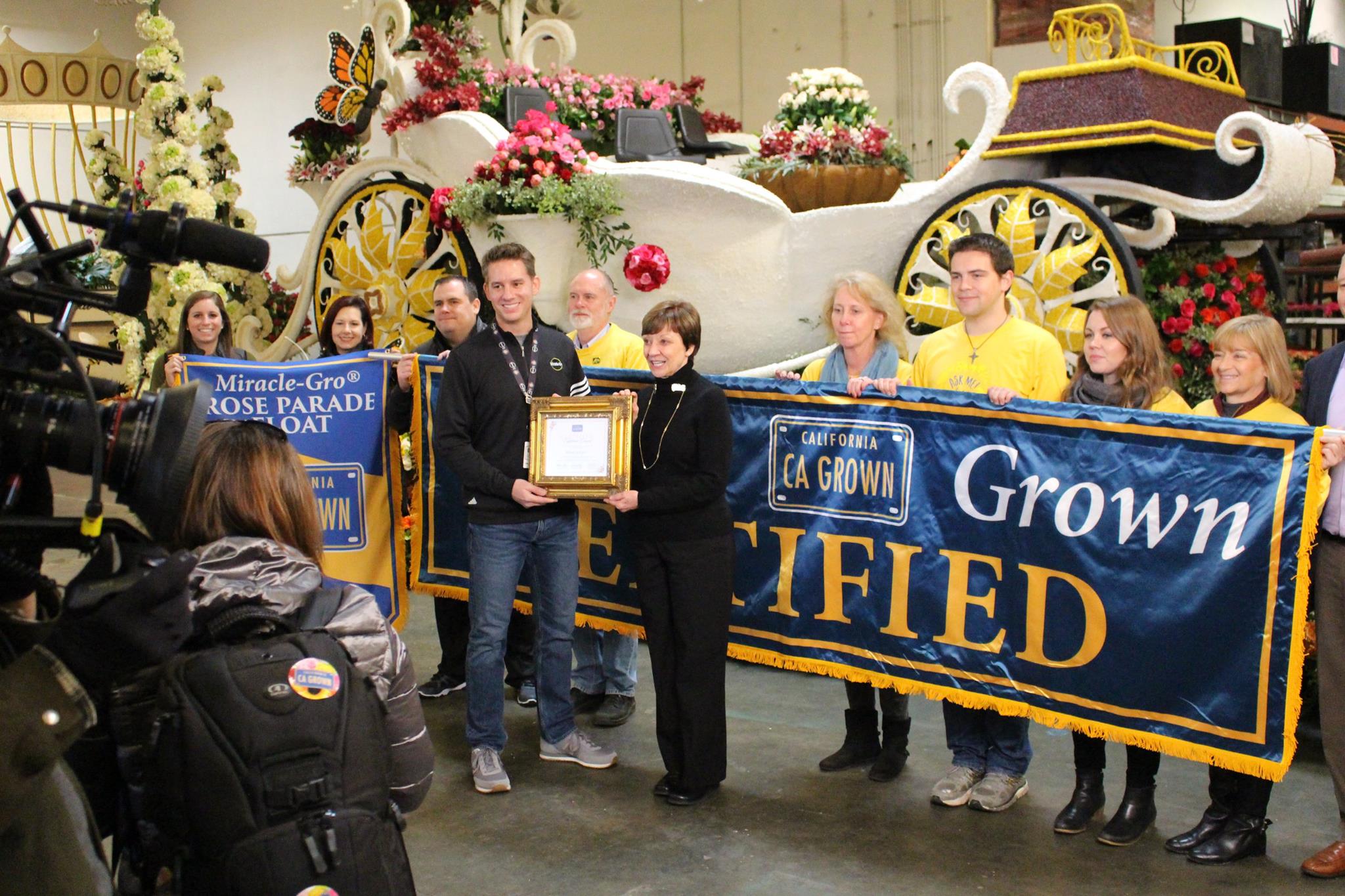
Secretary Ross with representatives of Miracle Gro and its award-winning float, ‘Everything’s Coming Up Roses.’
I was honored and very pleased to be asked back to officiate the California Grown certification ceremonies for flowers on floats in this year’s Rose Parade. You can’t help but get caught-up in the festive energy in Pasadena, and the stunning flowers on display add to a simply wonderful experience.

Cal Poly’s award-winning float, ‘A New Leaf.’
FTD provided flowers for dignitaries’ cars that really showcased the beauty and diversity of CA GROWN, and floats put together by the California Milk Advisory Board and Miracle Gro (an award-winner!) were really eye-catching this year.
Another highlight of the day was the Cal Poly Universities’ float –all student-designed and executed by teams of students in Pomona and San Luis Obispo. Called “A New Leaf,” it won the Founders Award for most beautiful float built and decorated by volunteers from a community or organization. The effort was creative, innovative and inspiring, and we’re reminded that young people who “learn by doing” prove that our future is in good hands!

The California Milk Advisory Board’s float.
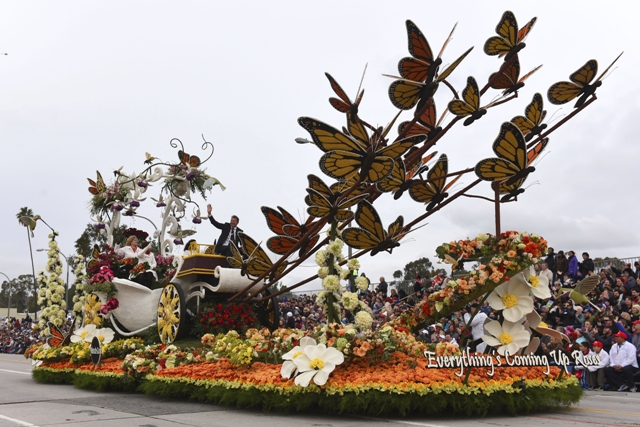
Miracle Gro’s float in action. It won the Queen’s Trophy for most effective use and display of roses.

FTD provided flowers for vehicles carrying dignitaries, such as the grand marshal.