

Planting Seeds - Food & Farming News from CDFA

State-funded autopsies for backyard poultry a prudent investment for early disease detection – From the Stockton Record

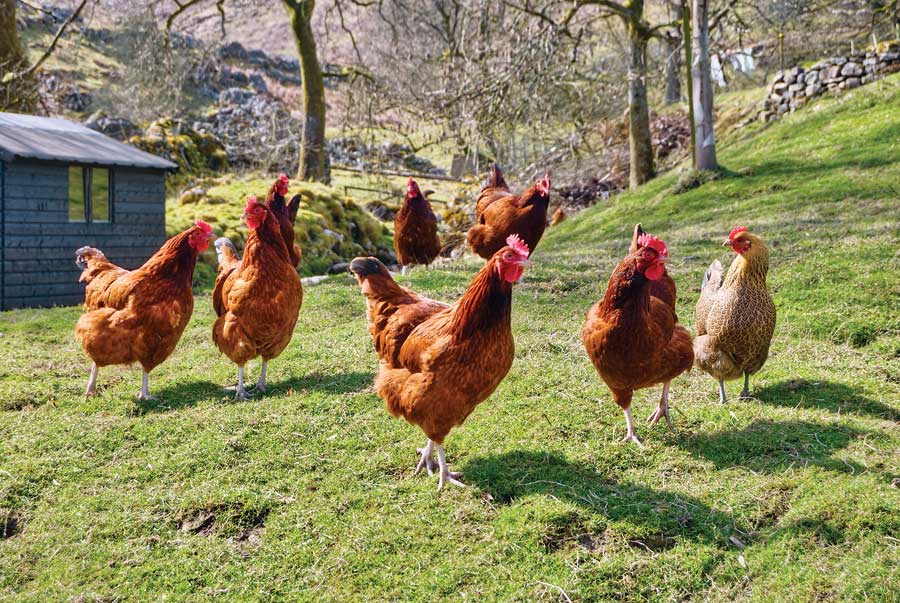
some chickens

By Reed Fujii

If you keep animals and they die, state animal health experts will examine the remains and report on the cause of death.

For a cow, pig or rabbit, the state laboratory charge is about $120.

For small pets, the fee is higher, nearly $195 for rodents such as hamsters and gerbils and $495 for cats and dogs.

But for a chicken or duck, the autopsy is free.

The little-known program is increasingly popular, the California Animal Health and Food Safety lab reports in the current October-December issue of California Agriculture, a University of California journal.

One or two birds may be submitted for a free necropsy (the term for a nonhuman autopsy) by owners of backyard poultry: chickens, turkeys, waterfowl or other birds raised for food.

In the six years through 2012, the program has received nearly 2,800 backyard poultry for analysis, about 14 percent of all birds from individual and commercial sources. And in each of those years, paralleling the growing popularity of keeping chickens at home, the number of birds from backyard flocks has grown, reaching 835 in 2012 compared with 173 in 2007, the researchers report.

Cherie Sintes-Glover, a 4-H poultry project leader in San Joaquin County and an expert on keeping chickens, said the state Backyard Flock program can help poultry owners quickly diagnose problems that may arise.

“It’s a great resource for the backyard chicken growers,” she said. “It provides them a report, and they can actually talk to a clinician or a doctor who performed the necropsy and get details on what they found. … They will actually help you find out what’s going on with your chickens.”

The program, which costs the state about $130,000 a year, protects both California’s multimillion-dollar poultry industry and, more importantly, public health, said Dr. Annette Jones, state veterinarian and director of Animal Health and Food Safety.

It’s really an early warning system – a canary in a coal mine, if you will – against avian-borne diseases that may emerge in backyard flocks.

“Generally what happens is these diseases come in through someone who, maybe not maliciously, smuggles in a parrot or a chicken; and it was in his backyard for a while; and then it spreads to the neighbor’s chickens; and it gets to a certain level and just explodes,” Jones said Friday.

“It’s like a forest fire. If you let that fire get to a certain size, … it’s very difficult to destroy it. It can affect millions and millions of birds.”

That most recently occurred in late 2002, when exotic Newcastle disease, a dreaded avian virus, was discovered in a Southern California backyard poultry flock. It was eventually found at thousands of sites, including commercial poultry farms. Before being eradicated, more a million birds were destroyed, and the cost was more than $160 million.

“That was horrible,” Jones said, recalling that she was in charge of the state’s response to the outbreak.

The agency is also on the lookout for signs of a bird flu or avian influenza, which many scientists warn could trigger a global flu outbreak on the scale of the 1918 pandemic.

“That, really honestly, is what our backyard bird program is aimed at – to be able to find and get rid of that virus if it comes into California,” Jones said.

While backyard flocks are generally not allowed in residential areas in Stockton or unincorporated San Joaquin County, they are legal in county areas with larger lots, such as rural residential zones. Residents of other cities should check with their local planning or code enforcement officials.

The testing labs nearest to San Joaquin County are in Davis and Turlock.

For more information about the program and instructions on how to submit poultry for testing – sorry, they do not return the remains – call the toll-free hot line, (866) 922-BIRD (922-2473).

Link to article – http://www.recordnet.com/apps/pbcs.dll/article?AID=/20131207/A_BIZ/312070320/-1/A_BIZ

Posted in Uncategorized | Leave a comment

Turnips on the Moon? From National Public Radio

Moon

The hyper-local food trend is really big right now. And apparently, NASA wants to make sure astronauts don’t miss out. The agency recently announced plans to grow cress, turnips and basil on the moon.

And to protect the plants from the harsh cosmic radiation and the moon’s lack of atmosphere, NASA researchers will be sending them off inside a seriously high-tech terrarium.

This could be good news for future space explorers: NASA’s Mars simulation has already proved that people can only deal with so much freeze-dried food. But while astronauts will probably appreciate the fresh veg, NASA says the real goal of this experiment is to see if humans could one day live — and farm — on the moon.

“This will be the very first life science experiment performed in deep space,” says plant scientistBob Bowman, one of the researchers behind the project. “Our goal is to show that the living organism can thrive in what really is a hostile environment,” he tells The Salt.

But growing plants on the moon won’t be easy. The moon has one-sixth the gravity of Earth — and the plants that NASA sends up there will have to deal with that, as well as facing extreme temperatures and harsh radiation.

“The moon’s a weird place,” Bowman says. “On the side that’s facing the sun, the surface temperature is about 150 degrees Fahrenheit. On the other side, it’s negative 150 degrees.”

he plant habitat that Bowman and his colleagues have designed contains seeds, as well as a nutrient-rich paper and enough air and water for the seeds to germinate and grow. The canister also has features that regulate light and temperature, and cameras that the researchers will use to track the plants’ progress over five to 10 days.

The entire thing is about the size of a coffee canister, and it weights only one kilogram. It’ll be hitching a ride on the Moon Express lander, a commercial spacecraft enrolled in the Google Lunar X Prize that’s set to launch sometime in 2015.

Till then, the researchers will be putting the canister through rigorous testing. They also hope to get school kids across America involved, by encouraging them to build their own canisters.

Bowman says this is just the first step. “Someday,” he says, “what we learn from this and the follow-up experiments will enable us to live in deep space.”

More at http://www.npr.org/blogs/thesalt/2013/12/03/248373683/moon-turnips-nasa-takes-gardening-to-new-heights

Posted in Uncategorized | Leave a comment

Growing California video series – The Beneficial Bean

The next segment in the Growing California video series, a partnership with California Grown, is “The Beneficial Bean.”

Posted in Uncategorized | Leave a comment

CDFA and growers work together to prepare for freezing temperatures

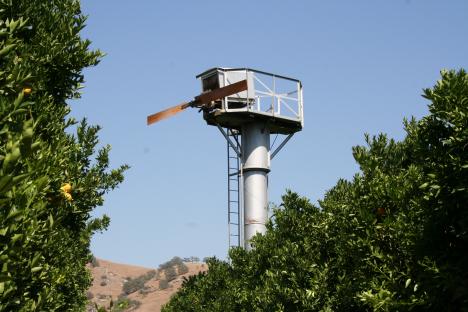
wind machineWith freezing temperatures in the forecast this week for much of the Central Valley, concern is high for growers of commodities in the midst of harvest, or close to it, such as citrus and avocados. The California Department of Food and Agriculture works collaboratively with these and other commodity groups to help minimize damage and protect consumers.

Citrus growers use a variety of methods to help protect their crops. They often utilize massive wind machines to keep the coldest air from settling on the orchard floor. They may also use water to preemptively form a layer of frost protection on the fruit. This is important because we know that while citrus can sustain temperatures well below freezing for several hours, a few degrees difference may be enough to save the crop.

The citrus industry assesses itself a mil fee—a small percentage of production–to pay for county and state regulatory programs that include CDFA’s Division of Inspection Services conducting temperature monitoring in the coldest areas. The Department uses temperature data to determine if crop samples need to be further examined for internal damage. The samples may be held for several days, because freeze damage may take up to 72 hours to show itself in citrus and 5 days for avocados. This precaution helps keep freeze-damaged produce out of the marketplace.

With CDFA and growers working together, every effort is made to ensure consumers are being sold the very best produce California has to offer.

Posted in Uncategorized | Leave a comment

Farm to Food Bank Month – Central Coast Farmers Give in Partnership with Ag Against Hunger

AG against Hunger image

It is ironic that California produces the largest bounty of agricultural products consumed in the US, and yet, 4.7 million of our residents live in poverty and often don’t have access to fresh fruits and vegetables. A solution to this problem was developed 24 years ago by farmers in Monterey, Santa Cruz and San Benito Counties when they realized that 20 percent of their product was going to waste. They collectively decided to create an agricultural nonprofit organization known today as Ag Against Hunger to collect and distribute all of their surplus produce.

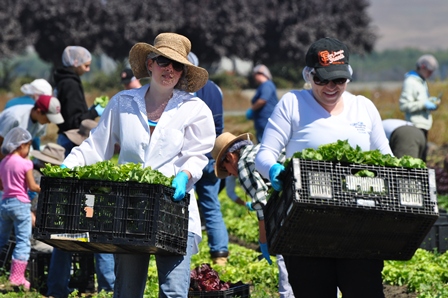
Gleaning session - photo courtesy of Ag Against Hunger image
Gleaning session – photo courtesy of Ag Against Hunger

Ag Against Hunger’s primary function is to prevent the waste of fresh vegetables and fruit. Instead of disking full fields of produce or paying fees to get rid of harvested product, producers choose to contact Ag Against Hunger to distribute the produce to food banks.

The organization is still supported by its founding community of local farmers, which provides board members along with financial assistance and, of course, produce. Since 1990, Ag Against Hunger has distributed over 212 million pounds of fruits and vegetables to help our local food bank partners across California.

To learn more about us, please visit our website. We look forward to seeing you on Facebook and/or Twitter, or even at a produce gleaning session!

This is the first in a series of blog posts to highlight December as Farm to Food Bank Month – an initiative by the California Department of Food and Agriculture and the California Association of Food Banks to double farm contributions to food banks by 2015.

Posted in AG Vision, Food Access | Tagged | Leave a comment

Video – Farm field trip program provides Ag education in Sonoma County

The Gold Ridge Resource Conservation District, based in Sebastopol (Sonoma County), sponsors a popular school field trip program to teach children about the origins of food and the need to preserve the resources that help produce it.

TEAM 2013 from Gold Ridge RCD on Vimeo.

Posted in Agricultural Education | Tagged , , | 1 Comment

Giving so much more than thanks

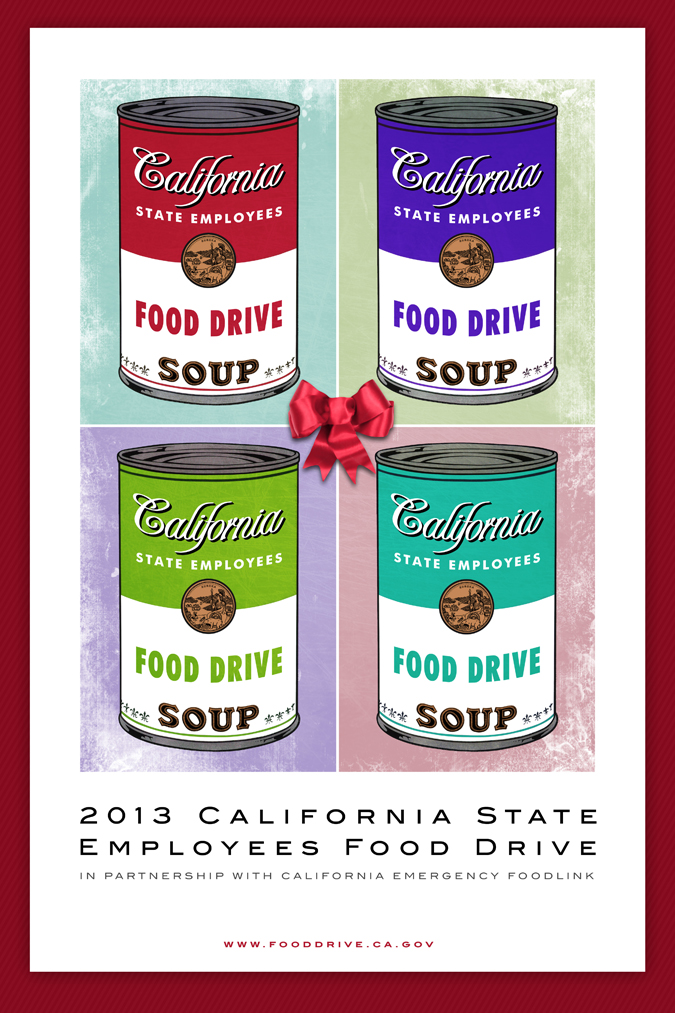
2013 State Employees Food Drive PosterThanksgiving is a uniquely American invention, and I think it must be one of our finest. The celebrations, the food, the parades and pronouncements give us an annual reminder of all that we are so thankful for – and also a reminder to share our blessings.

One benefit of my position as California’s Secretary of Agriculture is that my department coordinates the annual State Employees Food Drive, which last year donated 647,110 pounds of food to our partner, California Emergency Foodlink. Following the example of our state’s farmers and ranchers who provide so much of our nation’s and indeed our world’s food, state workers created this program back in 1975 – during Governor Jerry Brown’s first term. Since then, it has steadily grown from a fledgling collection of canned goods to a key component of our food banks’ annual plans.

2013 marked the passing of the food drive’s first statewide coordinator, Myron Curtis, who worked at the Department of General Services but found his real calling as the state workforce’s unofficial Santa Claus. Mr. Curtis leaves a legacy of generosity and joviality that inspired our state employees to support, expand and sustain the annual food drive. Here’s a quote from the DGS Winter 1980-81 newsletter: “Mr. Curtis’ efforts in the program cannot be overstated. He is the driving force behind the success of the food drive, and a concerned and compassionate member of his community.” (There’s also a nice photo of Mr. Curtis in the Nov.-Dec. 1981 issue, top right.) He sincerely enjoyed this annual effort, and he helped his coworkers see how much good they could all do together. He took pride in setting new records year after year – but as the numbers grew, Mr. Curtis always remained connected to why he was doing this important work. As he told his colleagues, “In many cases, the food you and I contribute has been, or will be, the only ‘holiday’ many people may have.”

I recently dedicated this year’s State Employees Food Drive to the memory of Mr. Myron Curtis. As you gather to give thanks, I encourage you to reflect on the people in your life who bring out the best in those around them – and I ask you humbly, as Myron Curtis did each year, to give as you are able.

Posted in Food Access | Tagged , , , | Leave a comment

San Jose biogas plant will turn food waste into energy – from the San Jose Mercury News

Dai Suganohttp://www.mercurynews.com/business/ci_24500983/greenwaste-biogas-san-jose-food-scraps-energy-zero-waste-green?source=rss#

By Dana Hull

The nation’s largest facility for turning food scraps into biogas is about to go online in north San Jose.

The project is a unique partnership between GreenWaste, which collects garbage, recycled materials and compostibles, and Zanker Road Resource Management, which operates recycling facilities. The two firms formed the Zero Waste Energy Development Company in 2011 to take organic recycling to the next level: extracting energy.

Food waste, largely from restaurants and commercial businesses across San Jose, will be processed at the Los Esteros Road location by 16 massive digestion chambers that each can hold 350 tons of waste.

The process takes roughly 21 days, during which the food breaks down into compost and methane biogas. The gas can then be converted into electricity to power the facility or for use as fuel elsewhere. The technology, known as “dry fermentation anaerobic digestion,” uses bacteria to break down organic matter in an oxygen-free environment and without using large quantities of water.

Scheduled to open later this month, the new facility arrives as California works to divert more materials — from garbage to food scraps to consumer electronics — away from landfills.

“This project is a big milestone for us,” said Jo Zientek, the City of San Jose’s Deputy Director of Environmental Services. “It’s built on a piece of property that’s an old landfill site that’s owned by the city already. And the project is a direct outgrowth of San Jose’s Green Vision.”

San Jose adopted its Green Vision agenda in 2007 with the goal of making the city a world center of clean technology innovation. Included in the plan is an effort to divert 100 percent of waste from landfills and convert waste to energy.

Organic waste such as yard trimmings and leftover food are typically buried in land fills. As the waste breaks down, the landfills often emit methane gas — a potent greenhouse gas that contributes to smog and climate change. Municipal solid waste landfills are one of the largest sources of human-related methane emissions in the United States, according to the EPA, and represent a lost opportunity to capture a significant source of energy.

“The capture rate at most landfills is not efficient,” said Eric Herbert, CEO of Zero Waste Energy, which is based in Lafayette. “Methane is 23 times more potent than carbon dioxide.”

Zero Waste’s anaerobic digestion facility, located near the southern tip of the San Francisco Bay, will be the first large-scale commercial operation of its kind in the United States. It’s being developed in three phases over the next several years, with each phase capable of processing 90,000 tons of organic waste each year. When fully operational, it will be one of the largest such plants in the world.

California utilities, including PG&E, are required to buy 33 percent of their electricity from renewable sources by 2020 via the state’s “Renewable Portfolio Standard.” Though much attention has focused on solar and wind power, electricity generated from biogas also qualifies for meeting the standard. So San Jose’s new facility could be replicated throughout the state by cities struggling to figure out how to handle their waste.

Other biogas projects are already operating in the Bay Area. Waste Management Inc., which recycles waste for several cities in Alameda County, is turning its decomposing garbage at the Altamont Landfill near Livermore into electricity and liquefied natural gas. The fuel is then used in the company’s garbage trucks.

“The interest in biogas is growing very quickly,” said Julia Levin, executive director of the recently formed Bioenergy Association of California. “In the long run, there’s a lot of potential for biogas to be used as transportation fuel. San Jose is on the cutting edge, but cities across California are trying to figure out how to better handle their waste. Biogas closes the sustainability loop on so many levels.”

Posted in Uncategorized | 1 Comment

Expired food to become cheap meals – from NPR

http://www.npr.org/blogs/thesalt/2013/09/21/222082247/trader-joes-ex-president-to-turn-expired-food-into-cheap-meals

Here’s some food for thought: One-third of the world’s food goes to waste every year. In the U.S., about 40 percent of our food gets thrown out. It’s happening on the farm, at the grocery store and in our own homes.

Lately, there’s been a lot of talk about what to do about it — from auctioning off food that’s past its prime to getting restaurants to track their waste.

Doug Rauch, the former president of Trader Joe’s, is determined to repurpose the perfectly edible produce slightly past its sell-by date that ends up in the trash. (That happens in part because people misinterpret the labels, according to a report out from Harvard and the Natural Resources Defense Council.) To tackle the problem, Rauch is opening a new market early next year in Dorchester, Mass., that will prepare and repackage the food at deeply discounted prices.

The project is called the Daily Table. Here’s what he shared with NPR’s Scott Simon, edited for brevity.

Simon: What gave you the idea?

Rauch: It’s the idea about how to bring affordable nutrition to the underserved in our cities. It basically tries to utilize this 40 percent of this food that is wasted. This is, to a large degree, either excess, overstocked, wholesome food that’s thrown out by grocers, etc. … at the end of the day because of the sell-by dates. Or [it’s from] growers that have product that’s nutritionally sound, perfectly good, but cosmetically blemished or not quite up for prime time. [So we] bring this food down into a retail environment where it can become affordable nutrition.

A retail environment is a store … or a food truck or something like that?

Yeah, it’s kind of a hybrid between a grocery store and a restaurant, if you would, because primarily it’s going to take this food in, prep it, cook it [for] what I call speed-scratch cooking. But the idea is to offer this at prices that compete with fast food.

Since the food is past its sell date, is it safe to eat?

Absolutely. As a matter of fact, if you have a product that says “sell by Sept. 1” or “Oct. 1” and, you know, it’s Oct. 2, most customers don’t realize you can eat that.

Still, is it a public relations problem to get people to buy stuff that is past due?

Well, we’ll see, won’t we? I think that the issue here is really how you talk about it and how you educate.

For instance, food banks for years have done this. I might say, without naming the names, one of the leading, best regarded brands in the large, national, food industry — they basically recover the food within their stores, cook it up and put it out on their hot trays the next day. That’s the stuff that we’re going to be talking about. We’re talking about taking and recovering food. Most of what we offer will be fruits and vegetables that have a use-by date on it that’ll be several days out.

Well, customers nevertheless have to consume the food pretty quickly.

As you know, when it comes to bread … we all know if you put it in the refrigerator it could last for weeks [even if it’s expired]. Milk lasts for days. It all depends on the temperature of your refrigerator, frankly.

Most people don’t know that, but you lose several days of shelf, whether it’s in code or out of code. Or do you leave the milk out on the counter while your kids are having breakfast? There’s all kinds of ways in which, if you handled it properly, you extend the life.

Is there any concern among, let’s say the people who might own a Trader Joe’s or some other food store today that, somehow, your places are going to be potentially underpricing them?

You’d have to ask them. But most of what we’ll be selling will be fruits and vegetables, freshly prepared product, stuff that’s really not brand-driven. And [we’ll be doing it] in areas that, frankly, are underserved. There aren’t Trader Joe’s in the inner-cities in America, at least to my knowledge.

This is about trying to tackle a very large social challenge we have that is going to create a health care tsunami in cost if we don’t do something about it. I don’t regard Daily Table as the only solution — there are wonderful innovative ideas out there — but I certainly think it is part of and is an innovative approach to trying to find our way to a solution.

Posted in Uncategorized | Leave a comment

Do beer-drinking turkeys taste better? From the Los Angeles Times

http://www.latimes.com/business/money/la-fi-mo-turkey-beer-20131108,0,4258790.story#axzz2lDIvUHnY

APphoto_Tipsy Turkeys

By Ricardo Lopez

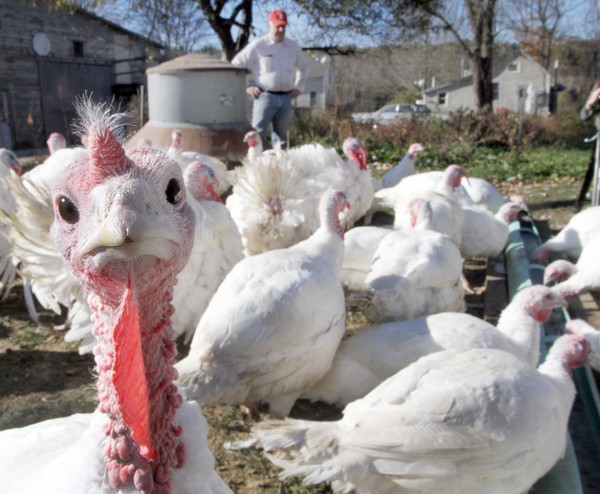
Turkeys will eat just about anything. Just ask Joe Morette.

In 1993, the New Hampshire farmer and his workers popped open a few cans of beer after work one summer day. When one his birds knocked over a can, it quickly began guzzling the spilled suds.

Ever since, Morette gives his flock of turkeys beer and swears the grain-based diet improves their taste, the Associated Press reports.

“Oh, yeah, it’s noticeable,” Morette told the wire service. “It’s not a strong, gamey flavor, it’s a nice turkey flavor.”

He’s currently raising about 50 birds for Thanksgiving Day.

Switching poultry and livestock to unconventional diets isn’t new. During last summer’s massive drought, for instance, one Kentucky farmer began feeding his cattle candy because the price of corn skyrocketed.

In France, some farmers have plied their cows with wine. They swear it gives their beef a more textured taste.

But what about PETA?

The animals rights group told the AP that Morette’s actions were questionable, criticizing the practice as profit-motivated. But poultry experts said the birds were probably not drinking enough to make them sick or even tipsy.

Posted in Uncategorized | Leave a comment