


Planting Seeds - Food & Farming News from CDFA

Crazy and not-so-crazy ideas for solving the California drought – from CBS News

Actor William Shatner plans to create a Kickstarter campaign to raise money for a water pipeline from Washington-state to California.

Actor William Shatner plans to create a Kickstarter campaign to raise money for a water pipeline from Washington-state to California.


By Michael Casey

California Gov. Jerry Brown has sounded the alarm over the state’s historic drought, warning that it will take “unprecedented actions” to solve the crisis.

That battle cry has produced a brainstorming session like no other – prompting celebrities, tech gurus, politicians and business leaders to offer a range of innovative and outlandish solutions for easing the dry stretch that is now in its fourth year and shows no sign of ending anytime soon.

Much of the talk has been about conserving water, plugging leaks and capturing runoff, highlighted to some degree in the state’s five-year Water Action Plan.

The first-ever statewide water restrictions, aimed at reducing water usage 25 percent, will see 50 million square feet of lawns replaced with drought-resistant plants, restaurants offering drinking water only on demand, and perhaps even golf courses letting their lush greens go brown.

But water savings alone won’t solve a problem of this size.

An analysis earlier this year from NASA satellite data concluded that the state would need 11 trillion gallons of water to recover from its dry spell. That’s roughly equivalent to filling up Lake Mead, the nation’s largest reservoir, one and a half times.

And the drought is only getting worse. With the El Nino weather pattern arriving too late and too weak to help replenish water in the region after record-low snowpack this winter, much of the West is in for another year of wildfires and more dry conditions.

As a result, the talk has turned to diversifying the state’s water resources. To some degree, that has meant dusting off grandiose projects like piping in water from out of state or expanding on technologies that convert wastewater or saltwater into clean water that could be used for industrial, agriculture or even drinking purposes.

Pipe dreams

Some voices have revived talk that dates back the late 1980s of building a pipeline to deliver water from out of state. Then, it was water from Alaska. Now, it’s William Shatner of Star Trek fame proposing to raise $30 billion for plan to pipe water from Seattle.

Never mind that much of the state of Washington is also in the grips of drought.

“I want $30 billion…to build a pipeline like the Alaska pipeline,” he told Yahoo Tech. “Say, from Seattle — a place where there’s a lot of water. There’s too much water. How bad would it be to get a large, 4-foot pipeline, keep it above ground – because if it leaks, you’re irrigating!”

Nancy Vogel, a spokesperson for the California Department of Water Resources, said neither Shatner’s plan nor anything like it is actually being considered.

“It would be cost prohibitive,” Vogel told CBS News. “Even if you could clear the environmental and legal hurdles, it runs counter to the state’s policy of reducing our reliance on imported water. We are not looking to take water from the Great Lakes, Pacific Northwest or Alaska.”

The state is, however, moving ahead with a $25 billion Bay Delta Conservation Plan that includes the construction of two tunnels that would pump water from Northern California to the southern part of the state.

Desalination technology

Reuse and desalination technologies seem to be gaining more traction, withdesalination garnering the most headlines of late. Technology that converts seawater into drinking water is standard fare in places like the Middle East where countries have little or no freshwater.

It has been slow to catch on the United States, mostly due to the high cost and huge amounts of energy needed to run the plants. But the drought is making the technology more politically palatable in places like California.

Poseidon Water is one of those companies already taking advantage of the changing attitudes toward unorthodox sources of water. It expects to open the biggest desalination plant in the western hemisphere later this year in Carlsbad, Calif. and is on the verge of winning approval for a smaller plant in Huntington Beach.

“Carlsbad will be a game-changer,” Poseidon’s Vice President Scott Maloni said. The plant is expected to produce 50 million gallons of drinking water each day and supply up to 10 percent of San Diego County’s water needs.

“It will open the door for desalination plants to be considered up and down the coast,” he said.

Wastewater reuse

Another technology that could expand its reach in California is the reuse of everything from storm water to wastewater. Most of the projects so far involve treating the water for use in agriculture fields, cooling industrial process or refilling groundwater aquifers.

“We are only scratching the surface of this incredible resource, which could address scarcity,” Jon Freedman, vice president of government affairs for GE Water & Process Technologies, said of the technology, which he estimates produces up to 10 percent of California’s water.

Among the 35 projects that GE Water has built in the state are one in American Canyon, where 3 million gallons of municipal wastewater each day is treated and used in area vineyards and golf courses. Another system in Redlands treats 6 million gallons of wastewater for use in cooling towers of a local power company, and still another in Oakley treats 4 million gallons, which is then piped into the San Joaquin River to help replenish the delta ecosystem.

The state has not yet gone as far as Singapore, which converts wastewater into drinking water called NEWater. Parched Wichita Falls, Texas, has also given“toilet to tap” recycling a try. And California could be next.

It is drawing up a framework for potable reuse of wastewater, and several municipalities are toying with the idea. San Diego is running a pilot project to test its feasibility, and millions of Orange County residents depend on drinking water that is treated and sent to an aquifer, before being pumped through the taps.

Futuristic ideas

Still, with things so desperate, some are looking even further afield to technologies that might seem more at home in an episode of “The Jetsons.”

One such proposal is something called atmospheric water generation. The technology literally strips moisture from the atmosphere, using a salt solution, and converts it into water.

“We could help dramatically with the California drought,” Abe Sher, the founder and CEO of Florida-based Aqua Sciences, which says it is talks with California and several other drought-stricken states about deploying its technology.

Until now, the company’s technology has been mostly used on a smaller scale to produce water, including at an oil facility in Saudi Arabia and after the 2010 Haiti earthquake. It also is in talks with Chinese officials to deploy its machines and is considering making units for home use.

“We could scale up the technology to produce millions of gallons a day,” Sher told CBS News. “Our source is everywhere on the planet. Even in dry places, there is water in the atmosphere … And it’s actually better than bottled water.”

Another futuristic approach comes courtesy of ionization.

The Florida-based company Rain on Request has developed a system featuring a 100-foot tower and 10 satellite towers 40 feet tall that it claims could induce rainfall within a 15-mile radius. The towers send a charge into the atmosphere, “creating a polarity that is conducive to rainfall,” explains business development manager Larry Gitman. The system requires humidity in the atmosphere or a nearby water source to function.

The company says it could boost precipitation levels between 50 percent and 400 percent. However, while it says the concept has proven effective in testing, it has not yet been put into place by any municipality. An online fundraising campaign on Indiegogo fizzled, raising just a few hundred dollars toward its $1,000,000 goal.

But the company has done the math and says all California needs is 50 of its stations “to solve the drought and restore rainfall levels to the entire state.”

“We think California is perfect for the technology because it’s right along the Pacific,” Gitman told CBS News. “We are in touch with a number of water authorities in California and we are confident that we will have a system in place in the near future.”

Peter H. Gleick, president and co-founder of the Pacific Institute and a leading expert on water and climate issues, said he has his doubts about some of the more far-fetched proposals.

“There is some controversy on how effective any of these technologies are,” said Gleick, who advocates reuse technologies and cutting waste as the best options for ending the drought.

“There are no shortage of ideas that might work,” he said. “There is a real shortage of ideas that are likely to be economically and politically feasible.”


Link to story


Posted in Uncategorized | Leave a comment

Earth Day & Invasive Species: Sacramento-area students meet “Hungry Pests”

Sixth-graders from Cowan Fundamental Elementary School don "Vin Vasive" masks as part of the Hungry Pests project. Look closely to see the many invasive pests that make up Vin Vasive's face...

Sixth-graders from Cowan Fundamental Elementary School don “Vin Vasive” masks. Vin Vasive is the main character in the USDA’s Hungry Pests program.

Sixth-graders from Cowan Fundamental Elementary School joined students at nearby Mira Loma High School in the Sacramento area this morning for an energizing and educational event built around the themes of Earth Day (April 22) and invasive species. CDFA Secretary Karen Ross applauded the students’ efforts to learn about the science behind efforts to detect and deter invasive pests and diseases.

CDFA Secretary Karen Ross thanked the students for becoming "citizen scientists" who can help protect California from invasive species.

CDFA Secretary Karen Ross thanked the students for becoming “citizen scientists” who can help protect California from invasive species.

The sixth-graders are launching a new curriculum entitled, “Hungry Pests Invade Middle School,” designed to teach students about the dangers of invasive species, how they harm our agricultural and environmental systems, and what can be done to keep them at bay.

The curriculum was developed by USDA’s Animal and Plant Health Inspection Service (APHIS) and meets Common Core State Standards and Next Generation Science Standards. The curriculum is multidisciplinary and includes English/language arts, history/social studies and math lessons. It is free for teachers to download at www.HungryPests.com.

The high school students have taken a hands-on approach to invasive species through their ongoing restoration project at neighboring Arcade Creek, where weeds and other invasive species are removed and replaced with native plants as students monitor and track their progress, weaving the project into their science curriculum.

Note – April has been designated as Invasive Plant Pest and Disease Awareness Month by the USDA


Posted in Agricultural Education, Environment, Invasive Species | Tagged , , , , , , | Leave a comment

Strawberry Fields…Forever – from the Growing California video series

The latest segment in the Growing California video series, a partnership with California Grown, is “Strawberry Fields…Forever,” a profile of a grower and his commitment to water efficiency.


Posted in Uncategorized | 1 Comment

If Bugs Took Vacations…

Note – April has been designated as Invasive Plant Pest and Disease Awareness Month by the USDA

Greetings from CaliforniaI’m going to tick off a list of some popular reasons why people from all over the world dream of coming to California (besides the beaches): mild weather, amazing food, a variety of landscapes to adventure, abundant natural resources, and a richly diverse population and mix of cultures.

Now, I’m going to list a few reasons why California is a place where invasive plant pests and diseases from around the world frequently come and thrive: on second thought, skip that. It’s the same list.

Fruit flies, wood-boring beetles, weeds, disease-spreading microorganisms and a host of other troublemakers all love California for the same reasons we do.

Our mild, Mediterranean climate allows pests to alter and accelerate their breeding cycles, find nourishment year-round, and generally survive better and multiply faster than they did in their home environment halfway around the world. The abundance and year-round availability of California’s varied plant life, from its agriculture to its natural environment and manicured landscaping, is a veritable oasis for pests that might have clung to survival on a much more limited diet and a rougher climate elsewhere. Think of how you’d feel landing in San Diego after a quick December flight from the East Coast…

The extraordinary diversity of California’s population also means that our state hosts travelers from around the world on a daily basis – and some of them bring in fruits and vegetables that are infested with pests, plants from “back home” that harbor diseases previously undetected here, or even soil or leaves or other plant matter that can carry microscopic organisms, diseases, even a fungus or a tiny worm.

Once here, these pests can quickly establish a foothold in our hospitable environment. Then, without any of the usual predators or parasites that kept them in check back at home, their populations can explode and wreak havoc in our beloved California.

How can you help? Well, April is Invasive Plant Pest and Disease Awareness Month, and that’s a good time for a quick rundown of ways to protect our state, courtesy of the folks at the Invasive Species Council of California (ISCC) in its handy handout based on the theme “Hello Invasive Species, Goodbye California”:

  • Keep a Lookout. Learn to identify the invasive plants and animals that affect your area. Learn more online at http://www.invasivespeciesinfo.gov/unitedstates/ca.shtml
  • Buy It Where You Burn It. Use local firewood to avoid giving bugs a free ride.
  • Plant Carefully. Buy non-invasive home and garden plants from a reputable local source.
  • Travel Safely. Please be sure to declare produce and plants at borders.
  • Keep it Clean. Before returning home from fishing, hunting and camping trips, wash outdoor gear, boats and vehicles to keep hitchhikers from damaging other areas.
  • Treat Pets Wisely. Always acquire pets from legal sources and never release any pets into the wild.
  • Report Sightings. Being a “citizen scientist” is fun and easy. There are many ways to make a difference:
    • Call California’s Pest Hotline at 800-491-1899
    • Contact your local county Agricultural Commissioner, www.cacasa.org
    • Visit whatisthisbug.org and download the Report A Pest app

California is our home – and it’s a wonderful place to visit, too. Let’s protect it from pests and diseases by being aware and alert.


Posted in Invasive Species | Tagged , , , , , | 1 Comment

Dollars and drops per California crop – from the California Water Blog at UC Davis

By Josué Medellín-Azuara and Jay Lund

When it comes to water, California’s irrigated agriculture is always under the public magnifying glass because it is the largest managed water use in the state and the economic base for many rural areas. During a prolonged drought like the current one, however, crop water comes under a microscope.

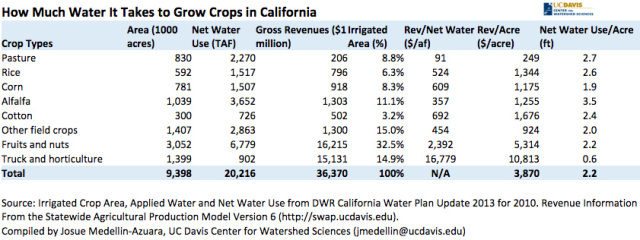
We have compiled a table to help answer questions on which crops use the most water and which crops provide the most economic “pop per drop.”

The estimates are very broad because California is so diverse in crop varieties, agricultural practices and local water availability. But the numbers are still useful for comparison purposes.

Note that the amount of water applied to a crop – “gross use” – is not the same as its “net use,” as some of that water seeps underground and replenishes aquifers or is reused downstream.

table-tiff

Some observations about the data:

  • The “truck (vegetables) and horticulture (garden plants)” crop group has the highest revenue per net water use, followed by the “fruits and nuts” group. Together, these two large crop categories account for nearly 86 percent of all crop revenue, but occupy only 47 percent of the irrigated cropland and use just 38 percent of the water applied to that land.
  • Fruits and nuts are grown on about one-third of the irrigated cropland and use one-third of the water, but produce nearly 45 percent of the total crop revenue.
  • Alfalfa, corn irrigated pasture and other livestock fodder account for nearly 37 percent of all net water crop use, but produce less than 7 percent of total crop revenue. However, the ranches and dairies that depend on these foodstuffs generate more than 22 percent of California’s agricultural production value, which totaled $45 billion in 2012.
  • Rice fields use a lot of water but also provide important bird habitat.

Josué Medellín-Azuara is a senior researcher and Jay Lund is a professor of civil and environmental engineering with the UC Davis Center for Watershed Sciences.

Link to blog post

Posted in Uncategorized | Leave a comment

USDA Reminds Farmers to Certify Conservation Compliance by June 1 Deadline

The U.S. Department of Agriculture (USDA) reminds farmers that the 2014 Farm Bill requires producers to file a Highly Erodible Land Conservation and Wetland Conservation Certification form (AD-1026) with their local USDA service center by June 1, 2015, in order to become or remain eligible for crop insurance premium support.

Most farmers already have a certification form on file since it’s required for participation in most USDA programs such as marketing assistance loans, farm storage facility loans and disaster assistance. However farmers, such as specialty crop growers who receive federal crop insurance premium support, but may not participate in other USDA programs, also must now file a certification form to maintain their crop insurance premium support.

“USDA employees are working very hard to get the word out about this new Farm Bill provision,” said Agriculture Secretary Tom Vilsack. “While many producers will not need to take action, we want to help make sure that those who are required to act do so by the June 1 deadline. We want all eligible producers to be able to maintain their ability to protect their operations with affordable insurance.”

Producers should visit their local USDA service center and talk with their crop insurance agent before the June 1, 2015, deadline to ask questions, get additional information or learn more about conservation compliance procedures. Producers that file their form by the deadline will be eligible for federal crop insurance premium support during the 2016 reinsurance year, which begins July, 1, 2015. USDA will publish a rule outlining the linkage of conservation compliance with federal crop insurance premium support. Go to http://go.usa.gov/3Wy5J to view a copy of the rule.

The Highly Erodible Land Conservation and Wetland Conservation Certification form is available at local USDA service center or online at www.fsa.usda.gov/AD1026form. When a farmer completes this form, USDA Farm Service Agency and Natural Resources Conservation Service staff will outline any additional actions that may be required for compliance with highly erodible land and wetland provisions. USDA’s Risk Management Agency, through the Federal Crop Insurance Corporation, manages the federal crop insurance program that provides the modern farm safety net for America’s farmers and ranchers.

Today’s announcement was made possible by the 2014 Farm Bill, which builds on historic economic gains in rural America over the past six years, while achieving meaningful reform and billions of dollars in savings for the taxpayer. Since enactment, USDA has implemented many provisions of this critical legislation, providing disaster relief to farmers and ranchers; strengthening risk management tools; expanding access to rural credit; funding critical research; establishing innovative public-private conservation partnerships; developing new markets for rural-made products; and investing in infrastructure, housing and community facilities to help improve quality of life in rural America. For more information, visit www.usda.gov/farmbill.

Link to news release

Posted in Uncategorized | Leave a comment

USDA announces record number of organic producers in US

organic produce certified vegetables

The U.S. Department of Agriculture (USDA) has announced that the organic industry continues to show remarkable growth domestically and globally, with 19,474 certified organic operations in the United States and a total of 27,814 certified organic operations around the world.

According to data released by the Agricultural Marketing Service’s (AMS) National Organic Program (NOP), the number of domestic certified organic operations increased by more than 5 percent over the last year. Since the count began in 2002, the number of domestic organic operations has increased by over 250 percent. The certified operations list is available at apps.ams.usda.gov/nop.

USDA is committed to connecting organic farmers and businesses with resources to ensure the continued growth of the organic industry. Along with programs to support conservation, provide access to loans and grants, fund organic research and education, and integrated pest management, USDA administers organic certification cost share programs to offset the costs of organic certification for U.S. producers and handlers nationwide.

Now, USDA is using funding from the 2014 Farm Bill to develop the Organic Integrity Database, a modernized certified organic operations database that will provide accurate information about all certified operations that is updated on a regular basis. The modernized system will allow anyone to confirm organic certification status using the online tool, support market research and supply chain connections, allow international verification of operator status to streamline import and export certificates, and establish technology connections with certifiers to provide more accurate and timely data. The initial launch is planned for September 2015.

Additional information about USDA resources and support for the organic sector is available on the USDA Organics Resource page at www.usda.gov/organic.

Link to news release

Posted in Uncategorized | Leave a comment

First Line of Defense – from the Growing California video series

Note – the USDA has designated April as Invasive Plant Pest and Disease Prevention Month.

From the Growing California video series, a partnership with California Grown, here is an encore presentation of “First Line of Defense,” a story about CDFA’s Border Inspection Stations.

Posted in Uncategorized | 2 Comments

Why food prices are drought resistant – from the Wall Street Journal

topics_foodprices_395

By Tim York and Daniel Sumner

California’s drought is raising concerns about whether fresh produce grown in the Golden State could run short, potentially raising prices nationwide. The reality is that there was little jump in produce prices last year, and consumers should expect only slight increases in 2015. To appreciate why, one must understand a bit about the geography, water infrastructure and economics of California agriculture.

The drought hasn’t affected California’s diverse regions uniformly. Most crops come from two areas: the Central Valley, including the Sacramento and San Joaquin valleys; and the coastal region, including the Salinas Valley, which is often dubbed America’s “salad bowl.”

The Sacramento and San Joaquin valleys are home to significant production of alfalfa, silage, rice, cotton and other so-called field crops, but are also a major source of fresh produce, including peppers, melons, grapes, oranges, tree nuts and tomatoes. Farmers in these valleys have typically relied on a mix of pumped groundwater and surface water deliveries via both the Central Valley Project—a huge network of dams, reservoirs and canals—and the larger California State Water Project. Most farmers, however, will receive no water from the CVP for the second year in a row, and the SWP is delivering only a fraction of normal allocations.

This, coupled with much higher groundwater pumping costs as more and deeper wells are required, has forced many farmers to shift out of thirsty field crops. But this decreased production has minimal effects on food prices because California accounts for a small share of the supply, or because these crops affect food prices only indirectly. For example, fewer acres of corn silage makes it more expensive to feed milk cows, but the subsequent effect on the price of cheese is small. Fresh produce, which generates high revenue per unit of water consumed, continues to be planted.

In the coastal region and the Salinas Valley—where crops include strawberries, avocados, lettuce, celery, cauliflower, broccoli and wine grapes—farmers do not receive surface water from the CVP or the SWP. Instead, rainfall is stored in local reservoirs or underground aquifers. Lake San Antonio sits at 5% capacity, and Lake Nacimiento at 29%. But groundwater is still available and farmers find it economical, given the value of the produce they grow.

Roughly half of California’s water flows undiverted for human use. Another 40% goes to agriculture, and the remaining 10% to cities. The environment requires a certain baseline of water that cannot be reallocated in a drought. Urban use is small and hard to change much, though Democratic Gov. Jerry Brown’s recently announced 25% mandatory reduction may help some. The bulk of water cutbacks will fall on agriculture but plumbing and economics determine where they will be made.

California voters passed a $7.5 billion water bond measure last fall, with $2.7 billion going toward increased storage. Legislation allowing regulation of groundwater will be implemented gradually over the next several years. These solutions will help, eventually.

Some farmers are adjusting planting schedules and shifting crops between growing regions to adapt. Others are rerouting water from annual field crops, which can be left unplanted for a year or two, to permanent crops such as fruit and nut trees. These adjustments assure a reliable supply to consumers, but they raise prices. Even so, this is a small factor compared with other costs. Produce prices are more likely to be influenced by labor shortages and the increase in California’s minimum wage in January 2016 to $10 an hour from the current $9. Governments in the region could scare off produce farmers if they were to place tight restrictions on irrigation practices. But that seems unlikely, at least for now.

So what does this mean for consumers? Even if water remains short over the next decade, an adequate supply of fresh fruits and vegetables should not be a concern. In a global market, produce suppliers from the U.S., Mexico, Chile and beyond compete to keep prices low. The rising cost of water in California is likely to increase the cost of production over time, and that will be reflected in gradually higher retail prices. But Golden State farms will remain reliable suppliers of the produce that consumers have come to expect.

Mr. York is the CEO of Markon Cooperative, a fresh-produce food-service purchasing cooperative. Mr. Sumner is the director of the University of California Agricultural Issues Center.


Link to article

Posted in Uncategorized | Leave a comment

For drinking water in drought, California looks warily to the sea – from the New York Times

Photo by Damon Winter - the New York Times

Photo by Damon Winter – the New York Times

By Justin Gillis

CARLSBAD, Calif. – Every time drought strikes California, the people of this state cannot help noticing the substantial reservoir of untapped water lapping at their shores — 187 quintillion gallons of it, more or less, shimmering so invitingly in the sun.

Now, for the first time, a major California metropolis is on the verge of turning the Pacific Ocean into an everyday source of drinking water. A $1 billion desalination plant to supply booming San Diego County is under construction here and due to open as early as November, providing a major test of whether California cities will be able to resort to the ocean to solve their water woes.

In California, small ocean desalination plants are up and running in a handful of towns. Plans are far along for a large plant in Huntington Beach that would supply water to populous Orange County. A mothballed plant in Santa Barbara may soon be reactivated. And more than a dozen communities along the California coast are studying the issue.

The facility being built here will be the largest ocean desalination plant in the Western Hemisphere, producing about 50 million gallons of drinking water a day. So it is under scrutiny for whether it can operate without major problems.

“It was not an easy decision to build this plant,” said Mark Weston, chairman of the agency that supplies water to towns in San Diego County. “But it is turning out to be a spectacular choice. What we thought was on the expensive side 10 years ago is now affordable.”

Still, the plant illustrates many of the hard choices that states and communities face as they consider whether to tap the ocean for drinking water.

In San Diego County, which depends on imported freshwater supplies from the Colorado River and from Northern California, water bills already average about $75 a month. The new plant will drive them up by $5 or so to secure a new supply equal to about 7 or 8 percent of the county’s water consumption.

The plant will use a huge amount of electricity, increasing the carbon dioxide emissions that cause global warming, which further strains water supplies. And local environmental groups, which fought the plant, fear a substantial impact on sea life.

The company developing the plant here, Poseidon Water, has promised to counter the environmental damage. For instance, it will pay into a California program that finances projects to offset emissions of greenhouse gases.

Still, some scientists and environmental groups contend that if rainy conditions return to California, the plant here and others like it could become white elephants. Santa Barbara, northwest of Los Angeles, built its desalination plant a quarter-century ago and promptly shut it down when rains returned.

Australia is a more spectacular case: It built six huge desalination plants during a dry spell and has largely idled four of them though water customers remain saddled with several billion dollars’ worth of construction bills.

“Our position is that seawater desalination should be the option of last resort,” said Sean Bothwell, an attorney with the California Coastkeeper Alliance, an environmental coalition that has battled California’s turn toward the technology. “We need to fully use all the sustainable supplies that we have available to us first.”

The rising interest in desalination is not simply a matter of desperation, though that is certainly a factor in states with growing populations and few obvious sources of new water. Advocates say the technology has improved markedly over the past 20 years. While the water can cost twice as much as conventionally treated water, it is still less than a penny a gallon, and that is starting to look tolerable in parched regions.

Desalination has grown into a huge industry, with more than 15,000 plants operating around the world. Many are small and treat brackish groundwater, requiring much less energy and costing less than seawater treatment. The United States already has scores of these smaller plants.

Huge plants treating seawater have been rare here, but they exist elsewhere, particularly in chronically dry regions like the Middle East. In little more than a decade, Israel has moved from perpetual water crisis to a point where it will soon get half its water from desalination. Israeli engineers have become sought-after partners in many cities, and are involved in the Carlsbad project.

The technological approach being employed here, and in most recent plants, is called reverse osmosis. It involves forcing seawater through a membrane with holes so tiny that the water molecules can pass through but larger salt molecules cannot.

A huge amount of energy is required to create enough pressure to shove the water through the membranes. But clever engineering has cut energy use of the plants in half in 20 years, as well as improving their reliability.

Future desalination plants also have the potential to blend well with the rising percentage of renewable power on the electric grids in California and Texas. Since treated water can be stored, the plants could be dialed up at times when electricity from wind or solar power is plentiful, and later dialed down.

However, as interest in desalination spreads, California and other states confront major decisions about the environmental rules for the new plants.

Both the intake of seawater and the disposal of excess salt into the ocean can harm sea life. Sucking in huge amounts of seawater, for instance, can kill fish eggs and larvae by the billions. Technical solutions exist, but they can drive up costs, and it is still unclear how strict California regulators will be with the plant developers.

Environmental groups argue that the embrace of desalination represents a failure to manage freshwater effectively. They want much more aggressive programs focused on conservation and on reuse of existing supplies, pointing out that half of municipal water here still goes to grass and other lawn plants. These arguments have sometimes carried the day, as they did when voters in Santa Cruz effectively killed a desalination plant.

Mr. Weston, the chairman of the San Diego County Water Authority, said his agency and others in the area had gone a long way toward embracing conservation. Since 1990, water use in the county has been cut 12 percent, even as the population has jumped 30 percent.

Long worried about water scarcity, the San Diego region helped to pioneer measures that ultimately spread across the country, including low-flow bathroom fixtures, more efficient washing machines and other innovations.

But these steps have not been enough to secure the region’s water future, Mr. Weston said. Thus, the water authority decided years ago, long before the current drought began, to move forward on the desalination plant.

It is in the late stages of construction, by an artificial bay opening to the sea in Carlsbad. On a recent day, the faint smell of glue wafted through the air as workers sealed joints on huge pipes. When it goes into operation, the plant will pump water through 16,040 cylinders containing the membranes that trap salt.

Peter MacLaggan, a vice president of Poseidon Water who is overseeing the project, said the plant was in some ways a response to longstanding public interest in desalination.

“Every time California has a drought, we get letters to the editor pointing out that there’s a lot of water in the Pacific Ocean,” he said as waves broke on the shoreline in the distance. “They say, ‘Hey, guys, what are we waiting for?’”

Santa Barbara, a chic tourist destination on the coast, could face severe water shortages within a year if the drought continues. The city is on the verge of spending $40 million to reactivate the long-mothballed desalination plant there.

That step would drive water bills up sharply, acknowledged the mayor, Helene Schneider. But, she added, “no water is a worse option than very expensive water.”

Link to article


Posted in Uncategorized | 2 Comments