


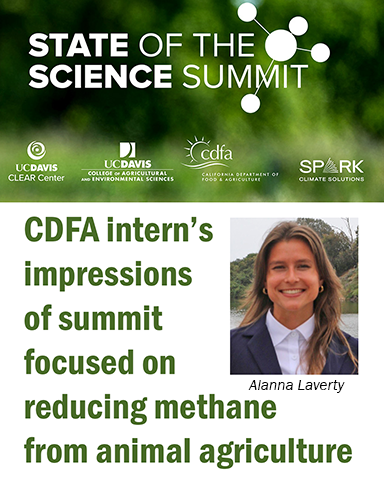
By Alanna Laverty, CDFA Intern
As I prepare for my final year of undergraduate education, I am spending the summer interning for the California Department of Food and Agriculture (CDFA). I am a Global Studies major at UC Santa Barbara and I am interested in global climate change, environment, and sustainability. I chose to intern at CDFA because of the unique opportunity to promote California agriculture’s climate goals, an imperative task as California is the nation’s top agriculture producer.
In June, I had the opportunity to attend the 2026 State of the Science Summit: Reducing Methane from Animal Agriculture at UC Davis. The scale at which this conference operates, with people from a variety of institutions and countries, highlights the magnitude of the potential of agriculture to be part of the solution to the climate crisis.
It was interesting to hear science and research offering solutions for agriculture’s enteric emissions. Animal genetics were a major topic of discussion, often accompanied by the phrase “genetics are a permanent solution.” Other areas of study included bromoform, early life intervention, and feeding strategies. Minerva Ringland with ReFED introduced a complimentary feeding strategy that uses food waste as part of animal feeding to reduce methane emissions, tackling both issues at once.
Beyond science, research and panel discussions looked at the human side of the issue of enteric emissions. Speakers highlighted that key ways to transform research conclusions into feasible realities include communication, implementation capacity, and building trust with farmers and ranchers. Jacquelyn Prestegaard with Texas A&M’s Extension program brought attention to the importance of uplifting the beef and dairy industries when marketing to customers rather than putting down competitors in order to bridge trust gaps.
Speakers also highlighted finance and economics. During supply chain discussions, panelists noted that dairy and beef industries are primarily small businesses and that it is important to reach producers where they are. Additionally, researchers advocated for funding for future research. These discussions brought home for me the interdisciplinary nature of finding solutions for enteric emissions.
I found the State of the Science summit emphasized the ability of agriculture to be part of the solution to the climate crisis. Though agriculture is often seen as an opportunity for soil carbon sequestration, there are simultaneous opportunities to reduce emissions from agricultural operations that could be better represented in climate and sustainability discussions. I was impressed to see that farmers and ranchers were at the forefront of everyone’s minds. Summit experts understood that farmers need to make a profit and that climate solutions need to be designed with that in mind. Solutions to enteric emissions are not just simply climate solutions; they are also farmer solutions.