

Planting Seeds - Food & Farming News from CDFA

From Protecting California’s Agriculture to Protecting Lives: Three CDFA Employees Receive Governor’s Medal of Valor

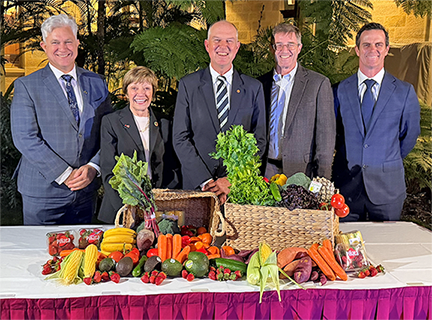
CDFA Medal of Valor Recipients Eduardo Guerrero (third from left); Bailey White (ninth from left), and Felix Salas (eight from right) — pictured with Secretary Karen Ross, Deputy Secretary Arima Kozina, Victoria Hornbaker, Plant Health and Pest Prevention Services Division Director (second from right), including relatives, and CDFA management staff.

Every day, California Department of Food and Agriculture (CDFA) Pest Exclusion employees stand on the front lines of protecting California’s agriculture from invasive pests and diseases. But on two separate days in 2024, three employees faced emergencies where their commitment to public service extended far beyond their normal duties.

Today, three CDFA employees with the Plant Health and Pest Prevention Services (PHPPS) Branch’s Pest Exclusion Program were recognized with the Governor’s State Employee Medal of Valor for demonstrating courage, quick thinking and selfless service during dangerous situations:

  • Eduardo Guerrero, Agricultural Technician III (Seasonal)
  • Felix Salas, Plant Quarantine Supervisor I
  • Bailey White, Plant Quarantine Inspector
Pictured: Eduardo Guerrero; Secretary Karen Ross, Bailey White, Felix Salas, Deputy Secretary Arima Kozina.

The awards were presented during the 2026 Governor’s State Employee Medal of Valor Award Ceremony at the California Highway Patrol Academy in West Sacramento, where 36 state employees from six departments were honored for heroic actions that protected the lives and safety of others. The award, given on behalf of Governor Gavin Newsom, is the state’s highest honor for heroism.

CDFA Deputy Secretary Arima Kozina participated as the department’s medal presenter.

“CDFA employees work every day to protect California’s food safety, strengthen agricultural communities and safeguard our natural systems, often in remote locations and under challenging conditions,” said CDFA Secretary Karen Ross. “Eduardo, Felix and Bailey represent the very best of public service. Their courage, professionalism and willingness to act in moments of crisis made a profound difference and exemplify the values we hold at CDFA.”

The Governor’s State Employee Medal of Valor is one of the highest honors bestowed upon California state employees and recognizes individuals who have demonstrated extraordinary courage, often placing their own safety at risk to protect the lives of others.

Eduardo Guerrero: Stopping a Wildfire Before It Spread

On September 8, 2024, Eduardo Guerrero was working at the Tulelake Border Protection Station in Siskiyou County when a passing motorist reported a small wildfire burning along the highway near state-owned housing cabins.

While his colleague, Plant Quarantine Inspector Erin Addison, called 911, Guerrero immediately grabbed a fire extinguisher and rushed toward the flames. In the hot, dry conditions of a remote area near the Modoc National Forest, the fire had already begun spreading through dry grass and threatened to become a larger wildfire.

After knocking down most of the flames, Guerrero noticed embers still burning. The fire reignited and he had to use a shovel and use dirt to put it out completely—working tirelessly for an hour at night. Knowing emergency responders could take time to arrive due to the station’s remote location and limited cell service, he returned to retrieve a shovel and continued working alone to extinguish the remaining hot spots.

His decisive actions prevented the fire from spreading, protected nearby state housing and helped ensure the safety of travelers and residents.

Felix Salas and Bailey White: Running Toward a Burning Vehicle to Save a Life

At approximately 2:40 a.m. on December 8, 2024, Felix Salas and Bailey White were working at the Blythe Border Protection Station in Riverside County when a vehicle traveling at a high rate of speed crashed into a safety barrier and became engulfed in flames.

Without hesitation, the two employees grabbed fire extinguishers and ran toward the burning vehicle. Working together, they extinguished the flames and discovered the driver trapped inside the heavily damaged cab, unable to escape because his leg was pinned.

With smoke filling the vehicle, Salas and White pried open the door to allow the driver to breathe. They remained with him, offering reassurance and keeping him calm until emergency medical personnel arrived.

Their bravery, teamwork and willingness to put themselves in danger saved the driver’s life.

CDFA congratulates Eduardo Guerrero, Felix Salas and Bailey White for their remarkable service and for representing the very best of California public service.

Posted in Uncategorized | Leave a comment

🌈 California Agriculture in Full Color: Celebrating Pride Month and the Diversity That Helps Us Thrive

Happy Pride Month! This June, the California Department of Food Agriculture (CDFA), is celebrating the colors that make California extraordinary — both in our communities and across our fields.

From strawberries and mandarins to lemons, avocados, grapes, and plums, California leads the nation in producing some of the world’s most iconic fruits and specialty crops. The same diversity that strengthens our agriculture is what strengthens our people.

We’re proud of the farmers, farmworkers, researchers, educators, partners, our CDFA employees, and advocates throughout agriculture, who help cultivate a more vibrant, inclusive, and resilient future every day.

This Pride Month, we celebrate the power of diversity, the richness of California agriculture, and the many colors that help our communities and farms thrive.

Thank you for the collaboration — with Jerry James Stone and the USDA National Agricultural Statistics Service.

Resources:

CDFA Office of Civil Rights
CDFA Diversity, Equity, and Inclusion Committee
CDFA Farmer Resource Portal
CDFA Farm Equity Program

Posted in Uncategorized | Leave a comment

CDFA Secretary Karen Ross Opened the 16th World Processing Tomato Congress in Monterey

Pictured: CDFA Secretary Karen Ross speaking at the 16th World Processing Tomato Congress, which opened on June 8 and brought together participants from around the world to discuss issues affecting the industry and opportunities for future collaboration.

California Department of Food and Agriculture (CDFA) Secretary Karen Ross delivered the opening keynote address at the 16th World Processing Tomato Congress, held in Monterey, California.

The biennial World Processing Tomato Congress brought together more than 400 delegates from over 30 countries, including tomato growers, processors, researchers, policymakers, and allied industry representatives. The event served as a global forum for collaboration and strategic planning within the processing tomato sector.

Secretary Ross welcomed attendees to California and highlighted the partnership between CDFA and the processing tomato industry. Her remarks also emphasized the importance of tomatoes to California agriculture—producing over 90% of the nation’s processing tomatoes.

The congress returned to California after previous gatherings were held in international production centers including Greece, Chile, and Italy. Organizers noted that California remained the leader in the processing tomato sector, accounting for the majority of U.S. production and a significant share of the global supply.

The opening session was organized by the California Tomato Growers Association and the global processing tomato industry.

Pictured: Mike Montna (left), representing the California Tomato Growers Association, introduced Secretary Karen Ross before her remarks on June 8, 2026 in Monterey, California.
Posted in Uncategorized | Leave a comment

During California Invasive Species Action Week 2026, CDFA and Growers Team Up Against Broomrape

June 6-14 is California Invasive Species Action Week! Today, we’re talking about an invasive, parasitic plant called broomrape. Like so many others, it is a threat not just to agricultural crops like tomatoes, cauliflower, peppers and beans, but also to the state’s natural biodiversity.

CDFA’s Broomrape Program helps growers protect California’s processing tomato industry, in collaboration with a Broomrape Board made up of growers, processors, and industry representatives. In 2024, California tomatoes for processing consisted of 228,000 acres planted, had an estimated value of $1.24 billion, and produced 11 million tons of tomatoes.

Susceptible food crops may experience up to 70 percent annual crop losses in areas infested with broomrape. It also impacts commercial seed production and can make agricultural land unusable.

CDFA is a partner of California Invasive Species Action Week! Throughout this week, keep an eye out for our blog and social media posts, along with partner stakeholders agencies and organizations.

Post: June 9, 2026 – CDFA Urges the Public to Protect California’s Citrus from Invasive Pests

Posted in Uncategorized | Leave a comment

CDFA Urges the Public to Protect California’s Citrus from Invasive Pests

This California Invasive Species Action Week 2026, California residents are being urged to act against invasive pests that threaten our state’s natural resources. From the Asian citrus psyllid (ACP) to invasive fruit fly species, there are several invasive pests that could devastate California’s citrus.

One simple way residents can act is by staying informed!

✅ Stay up to date on potential plant or pest quarantines in your area.

✅ Don’t move plant material between, into or out of quarantine areas.

✅ Inspect your backyard trees for signs or symptoms of pests and diseases and report them to the CDFA Pest Hotline at 1-800-491-1899.

Together, we can slow the spread of invasive pests in California.

CDFA is a partner of California Invasive Species Action Week! Throughout this week, keep an eye out for our blog and social media posts, along with partner stakeholders agencies and organizations.

Posted in Uncategorized | Leave a comment

Update: New World Screwworm detected in Texas, New Mexico; California remains clear 

The United States Department of Agriculture (USDA) has confirmed that the New World Screwworm – an invasive, destructive parasite – has been detected in Texas and New Mexico, marking the the pest’s first incursion into the United States since it was successfully eradicated in the 1960s. 

Current Status for California 

There are currently NO confirmed detections of New World Screwworm in California. The California Department of Food and Agriculture (CDFA) is actively monitoring the situation and working closely with local, state, and federal health officials. 

What is New World Screwworm? 

New World Screwworm is a parasitic fly that poses a severe threat to warm-blooded animals, including livestock, wildlife, pets, and, in very rare cases, humans. 

Unlike common black flies that eat dead tissue, screwworm larvae (maggots) feed on living tissue inside open wounds. Their feeding expands and deepens the wound, attracting more flies to lay eggs. If left untreated, this cycle can be fatal to the animal. Female flies only mate once in their lifetime.

The previous infestation in the US was eliminated using the Sterile Insect Technique (SIT), a process where sterile male flies are released into the wild to prevent reproduction. USDA resumed release of these sterile flies along the southern U.S. border in response to the parasite’s current spread. 

Key Takeaways for Animal Owners and the Public 

Because of the screwworm’s spread northward through Central America and Mexico into Texas and New Mexico, California is taking proactive steps to protect our agricultural economy, wildlife, and workers. 

For more than a year, veterinarians and CDFA experts have been engaged in detection and outreach activities with producers and colleagues at the federal, state, and local levels. Our staff is in constant contact with our One Health partners at the California Department of Public Health (CDPH) and the California Department of Fish and Wildlife (CDFW) to maintain surveillance and response preparedness. The One Health approach is a collaborative concept that recognizes and addresses the close link between human, animal, and environmental health. 

Best Practices

We need the help of all California animal owners to keep this pest out of our state. Please follow these best practices: 

  • Check your animals daily: The absolute best defense is keeping an eye on animals. Routinely inspect livestock, horses, and pets for any signs of wounds or unusual fly activity. It’s important people traveling with their pets to and from Mexico and other infested regions carefully check them for wounds or signs of infestation. 
  • Treat wounds immediately: Keep any open wounds clean, treated, and covered to prevent flies from laying eggs. 
  • Know the human risk: Human cases are incredibly rare, isolated, and cannot spread from person to person like a virus. 
  • What to do if you suspect Screwworm: Do not wait. If you see signs of unusual larvae in an animal’s wound, immediately contact your local veterinarian or reach out directly to your CDFA District Office

Stay Updated

For the latest official data and status maps, please monitor these tracking pages: 

Posted in Animal health, Invasive Species | Tagged , , , , | Leave a comment

CDFA welcomes the appointment of Carney King as Deputy Secretary of Legislative Affairs

CDFA Secretary Karen Ross performs the swearing-in ceremony for the appointment of Carney King to the position of Deputy Secretary of Legislative Affairs.

Carney King has been appointed the Deputy Secretary of Legislative Affairs at the California Department of Food and Agriculture. King has been CDFA’s Legislative Manager since 2025, and came to the department after a distinguished career in the US Army and service in several legislative offices.

He was a Policy Consultant in the Office of Senator Richard Roth in the California State Senate from 2022 to 2025; a Legislative Aide in the Office of Senator Bill Dodd in the California State Senate in 2020; Site Lead for the Covid Testing Task Force in the California State Senate from 2020 to 2022; and a Senate Fellow in the Office of Mike Morrell in the California State Senate from 2018 to 2020.

He served as a CH-47F Flight Engineer in the United States Army from 2005 to 2011. King earned a Master of Public Administration Degree from the University of Southern California and a Bachelor of Science degree in Political Science from the University of Oregon.

Carney is an avid golfer who enjoys spending time with his wife and two kids. Congratulations, Carney!

Posted in Legislation | Tagged , , | Leave a comment

Farm to School benefits small farms like Old Grove Orange in Redlands

(L-R) Farm to school programs help sustain small farmers like the hardworking, passionate team pictured with Anna Knight, a fifth-generation farmer at Old Grove Orange in Redlands. For local school districts, Old Grove Orange grows a variety of seasonal produce, including those offered by farmer Jackie to students while hosting an Old Grove Orange Mini Farmers’ Market in the Corona-Norco Unified School District.

Farm to school programming provides the consistent demand needed to sustain local small farmers who take pride in benefitting student health and the local economy. 

“Small farmers need to adapt to survive!” said fifth-generation farmer Anna Knight of Old Grove Orange. “We’ve done everything from farmers’ markets to community supported agriculture, but for the last 20-plus years, 100% of the produce we grow has gone directly to local K-12 public school districts. We wouldn’t be here without the visionary nutrition services programs of Greater L.A., and these partnerships are how we keep farming forever!”

Old Grove Orange is a family farm stewarding 81 acres in Redlands, California. Over the last 21 years, Old Grove Orange and the 30 farm families contributing to its food hub have worked with 50+ school districts in the Greater Los Angeles area. Their thoughtful approach to farm to school provides students with experiential education programs that connect them to the land, the farmers and the products served in their school meals. 

As a three-time grant recipient of the CDFA Farm to School Incubator Grant Program, Old Grove Orange has increased its production of minimally processed seasonal vegetable products designed specifically for the school market. School districts can often find it challenging to cook whole vegetables due to staff or equipment capacity; therefore, Old Grove Orange’s pre-cut, portioned and packaged produce allows for an easier adoption of local products into school meals.

Click here to learn more about Old Grove Orange.

Posted in Agricultural Education, CDFA Inspection Services, Community-based Food System, Environment, Farm to School, Food Access | Tagged | Leave a comment

Happy National Olive Day – June 1! 🫒🌞🌿

Thank you for the collaboration: USDA National Agricultural Statistics Service and Jerry James Stone.

Today, we celebrate one of California’s iconic crops and the people who make it possible. California leads the nation in olive production, thanks to its favorable climate, fertile growing regions, and the hard work of dedicated growers and farmworkers.

A special recognition goes to olive growers, farmworkers, processors, olive oil producers, packers, distributors, retailers, and everyone throughout the olive supply chain who helps bring high-quality California-grown olives to tables across the country.

Whether enjoyed as a snack, added to favorite recipes, or transformed into premium olive oil, California olives are a testament to the skill, dedication, and passion of the people behind them.

Thank you for helping California continue to produce some of the finest olives and olive oil in the world.

Resources:
Olive Oil Commission of California
CDFA Farmer Resources
California Grown

Posted in Uncategorized | Leave a comment

USDA Announces Enrollment Period and Payment Rates for Specialty Crop Farmers

The U.S. Department of Agriculture (USDA) has announced payment rates and the enrollment period for the Assistance for Specialty Crops Farmers (ASCF) program. USDA will issue $1.625 billion in payments to eligible specialty crop producers in response to elevated input costs and market disruptions resulting from foreign competitors engaging in unfair trade practices that impeded specialty crop exports.

Producers who have a Login.gov account can access and submit their pre-filled application starting today, June 1, 2026. Producers who do not have a Login.gov account or prefer to enroll in person at their local Farm Service Agency (FSA) office can request their prefilled application beginning June 8, 2026. The ASCF enrollment period closes on Aug. 7, 2026.

These payments are authorized under the Commodity Credit Corporation Charter Act and are administered by the Farm Service Agency (FSA). Specialty crop payments are intended to provide financial support to allow producers to pay for production and marketing inputs in the face of significant market disruptions during the 2025 growing season.

How to Apply

Pre-filled applications will be available online to producers with a Login.gov account who timely filed their 2025 crop acreage report for eligible specialty crops. Starting on June 1, 2026, producers who have a Login.gov account can access and submit their pre-filled application from fsa.usda.gov/ascf. Beginning June 8, 2026, producers can request their pre-filled ASCF application from their FSA county office.

The deadline to submit completed ASCF applications is Aug. 7, 2026. Producers can complete their applications online or submit them to their FSA county office.

Payments will be issued as applications are submitted and approved, beginning as early as the first week of signup.

Login.gov

Login.gov is the public’s one account for government. Producers can use one account and password for secure, private access to participating government agencies, including FSA.

To apply for ASCF online, producers can start by visiting fsa.usda.gov/ascf to create their Login.gov account. Producers who have an existing Login.gov account can work with FSA using their existing account.

With a secure Login.gov account, producers can be amongst the first to apply for ASCF, allowing them to view, complete, certify, and submit their application as well as track their application and payment status.

For assistance creating a Login.gov account, visit login.gov/help.

Eligibility

Specialty crop acres of eligible crops reported to FSA as an initial, double crop, repeat crop, or subsequent crop by April 24, 2026, will be used to determine ASCF program payments. Acreage that is reported as a cover crop, prevented planted, or with an intended use of grazing, left standing, green manure, silage, forage, volunteer, or experimental will not be used to determine ASCF program payments.

For a list of eligible specialty crops visit fsa.usda.gov/ascf. Specialty crops grown in a controlled environment are not eligible, except for mushrooms.

Crop insurance linkage is not required; however, USDA strongly urges producers to take advantage of the new risk management tools provided in the Working Families Tax Cuts Act, also known as the One Big Beautiful Bill Act, to best protect against future price risk and volatility.

Payment Calculations and more information on ASCF are available online at fsa.usda.gov/ascf. Producers can also contact their local FSA county office.

Posted in Specialty Crops | Tagged , | Leave a comment